
• Skip to primary navigation
  • Skip to main content
  • Skip to primary sidebar
  • Money Management
    • Debt Reduction
    • Credit
    • Mortgages
    • Mutual Funds
    • Tax Strategies
    • Loans
  • Budgets
    • Saving Money
    • Income
  • Banking
    • Checking Accounts
    • Check Writing
    • Fraud
    • History
  • Entrepreneurs
    • Entrepreneur Interviews
    • Money Making Ideas
    • 3D Printing
  • Resources
  • Retirement
  • About
    • Privacy Policy

Personal Finance Blog

Tips And Stories To Help You With Managing Money

  • Privacy Policy
  • Saving Money In 2018
You are here: Home / Archives for Finance / Personal Finance

Personal Finance

Don’t Let Lifestyle Inflation Overwhelm Your Finances

April 10, 2014 By Kevin Mercadante

Protecting Your Money So It Can Grow In Value

So often, people watch their careers flourish and their incomes grow – but no matter how fast they do, somehow their overall financial situation seems to go nowhere. Sometimes, it even gets worse. How can that be? It’s called lifestyle inflation, a kind of financial cancer that can render your finances a complete wreck, even as your career takes off.

It’s important to realize that income and net worth are not the same thing. Income is how much you make, but net worth is what you’re left with after all your living expenses are paid. If those expenses are too high, you will never see your net worth rise – and your finances improve – no matter how high your income is. That’s what lifestyle inflation does to your finances. And it’s something we all need to be on the lookout for.

What is Lifestyle Inflation?

Lifestyle inflation has become so pervasive that it even rates a dedicated definition from Investopedia.com:

“Increasing your spending when your income goes up. Lifestyle inflation tends to continue each time someone gets a raise, making it perpetually difficult to get out of debt, save for retirement or meet other big-picture financial goals. Lifestyle inflation is what causes people to get stuck in the rat race of working just to pay the bills.”

That’s the general idea. On a mechanical level, lifestyle inflation looks like higher living expenses, more debt, and very little in savings and investments. You’re in the trap if that combination remotely describes your financial situation.

How Lifestyle Inflation Overwhelms Your Finances

Lifestyle inflation is virtually a default setting. Unless you’re intentional about managing your finances, your living expenses will continue to grow, eating up every extra dollar you earn and sometimes even more.

Have you ever played that game what would you do if you had $1 million? There are different versions of that question, but it comes down to what would you do if you suddenly came into a very large windfall of money? It’s fun to imagine, but if you listen to the answers that most people give you begin to get a solid idea as to how dangerous lifestyle inflation can be.

When confronted with the prospect of coming into a large amount of money, people almost instinctively read off a laundry list of how they would spend the money. Very few ever contemplate how they might save and invest it. In reality, this is what often happens to people who win the lottery or inherit a large amount of money. In short order, they end up broke.

That’s the essence of lifestyle inflation. We all have an almost limitless number of wants in life, and when the money becomes available those wants are magically converted into needs. The difference between wants and needs is more than just semantics. Wants are something that we would like to have – needs carry a certain urgency. The transition from wants to needs often happens as a result of a pay raise, a promotion, or the receipt of a windfall.

The Worst Part – You Don’t Even Know It’s Happening

Most times, you won’t even recognize that lifestyle inflation is taking place. That’s because the whole concept is rooted in emotion, rather than logic.

Let’s say that you get a $10,000 increase in pay. $3,000 will go for income tax and payroll deductions, so you’ll really have only $7,000. You reason that this is the perfect time to replace your old clunker with a brand-new car. You then go from no car payment, to $400 per month. But what the heck, with a big fat raise swinging the monthly payment should be no problem, right?

There’s a good feeling that comes with having extra money. So in addition to buying yourself a new car, you also increase your eating-out from once per week to twice, at an extra $50 per week. You also decided you need to new clothing, and about $1,000 should do it.

Let’s add that up. $400 per month a new car payment comes to $4,800 per year. The extra restaurant meal per week at $50 each comes to $2,600 per year. And then there’s the $1,000 for clothing. $4,800 plus $2,600 plus $1,000 comes to $8,400! Not only does that combination eat up your entire $7,000 net increase in pay, but you’ve also overspent.

Making more money feels good, and that’s the problem. When you feel good, your defenses are down and you enjoy the extra financial freedom. Since it quietly, gradually goes into consumption, none of the extra income ever makes it into the bank.

That’s how lifestyle inflation creeps into your life, and keeps you from ever getting ahead financially.

Preventing Lifestyle Inflation From Happening

It’s easy to see lifestyle inflation happening in the lives of other people. But it’s more complicated when we’re engaging in it ourselves. If that’s been your pattern in the past – and the evidence will be inflated credit card balances and an undersized bank account – you’ll have to take concrete steps to get it under control.

Try these steps to get out of the lifestyle inflation trap, and put you on the path to financial independence:

  • Track your spending – make sure you know exactly where your money goes
  • Reduce or eliminate any expenses that are not absolutely necessary
  • Set up payroll savings plans; you can direct money into a savings account, mutual funds, and of course retirement plans (yes, even IRAs if you don’t have an employer plan)
  • When ever you get a raise, increase your payroll savings by the amount of the net pay hike
  • When ever you get a cash windfall, use it either to payoff debt, or to put into savings and investments – don’t give yourself the opportunity to spend it on something you don’t really need

Unfortunately, lifestyle inflation can easily become a way of life – it is for millions of people. Breaking out of that habit will be like going on a diet, except that this one will be a financial one. That means that it will be painful at first, but once you get control of your finances, your life will get progressively easier. It’ll will be like creating a new automatic pilot for your life, one that will stack the long-term deck in your favor.
Filed Under: Personal Finance Tagged With: money management, Personal Finance

Achieving A Financially Successful Life

April 19, 2013 By Sherry Tingley

One of the basic foundations for building and maintaining a successful financial life focuses on using regular income to provide you with a basic lifestyle and money in savings to meet emergencies. This may take years to accomplish, but proves to be the foundation of financial success.

Good Cash and Credit Management Practices

Managing cash and credit is a skill that can be beneficial for a lifetime. People sometimes fail to realize that credit card companies are in the business of making money off people who can’t do basic math or don’t project into the future how much their purchases will really cost. They bank on human nature to be lackadaisical with their payments.

Some Americans have adopted credit card usage as a “way of life.” Credit cards have been singled out as one of the most perilous consumer financial products and frequently leads to over indebtedness. Using credit cards to pay for unexpected difficulties is one of the biggest problems.

Managing Expenditures Adequately

Being able to keep your living expenses well below your income level is ideally the best strategy to take. Your entire financial success depends on being able to do this. This allows you to build up an adequate savings to handle unforeseen emergencies and helps you stay out of thinking that your best solution is to use a line of credit to pay your debts. It also allows you to build up savings for investment purposes. If you find that you aren’t in this position, then it is time to think about alternate ways to bring in income.

Income and Asset Protection

Insurance is one way to protect your assets. Car insurance minimizes losses from car accidents. Home insurance minimizes losses from accidents as well. Life insurance can protect your children in the event of your death. Using insurance to protect you from losses is wise, but be sure to do research into the details of each policy and carefully examine the risks you are taking.

Investing Wisely

No one wants to lose money so investing wisely is a skill worth learning. Because money can return a positive rate of return over time, it is best to start saving early in life. A $10,000 investment can grow to $57,430 in 30 years at 6% interest.

Preparing for Retirement and Estate Planning

You really need to start planning for retirement at the beginning of your earning career. Many folks put this off until it really is too late to do anything about. Starting at an early age, the time value of money can really work for your benefit.

Achieving financial success is a life time goal, but takes daily effort. The more effort you input, the more you will enjoy rewards.

Filed Under: Personal Finance Tagged With: Personal Finance

5 Lifetime Financial Objectives

April 2, 2013 By Sherry Tingley

Financial success means something different to every person. Some want to have enough money to pay the rent, pay their mortgage and just get by, while others seek to acquire a huge estate. You may want to be a millionaire by age 30, however most people just want to have a comfortable lifestyle. Few people reach financial success without restraining their current spending.

Becoming active in savings for future consumption is a habit everyone needs to get into. According to the book “Personal Finance,” by E. Thomas Garman, from the Virginia Polytechnic Institute and State University, lifetime financial goals generally cover 1.) Maximizing Earnings and Wealth 2.) Practicing Efficient Consumption 3.) Finding Life Satisfaction 4.) Reaching Financial Security 5.) Accumulating Wealth for Retirement and an Estate.

Maximizing Earnings and Wealth

Having an abundance of money and valuable assets requires one fundamental principal: spending less than you earn. Budgeting and planning for this is a top priority. Another goal then needs to be focused on maximizing your earnings. You can accomplish that through employment, entrepreneurship and/or investing. How you do this is entirely up to you and unique to your particular interests and passions.

Practicing Efficient Consumption

We use money either for consuming or saving. Efficient consumption comes from practicing good financial skills, like keeping good financial records, avoiding impulse spending, using credit wisely and keeping living expenses down. Failing to do this is often a result of carelessly spending money on non-essentials and ignoring monthly obligations.

Finding Life Satisfaction

Your satisfaction with life may come from being debt free, owning a home, going on vacations, educating your children, living well in retirement and leaving an inheritance for your children. All of these goals can be achieved through a variety of career paths and every day investment decisions. Financial success offers you a better quality of life whether you want to live well or give your money away.

Reaching Financial Security

Financial security is not about having earned a specific amount of money. It is more in the comfortable feeling you gain when your resources will adequately fill any needs you might have and most of your wants. Free from doubt, anxiety or fear about money is a wonderful place to be. You will need to have a career with potential, an adequate emergency fund, investments an estate plan and a will. Setting short term and long term goals is absolutely essential to achieving financial security.

Accumulating Wealth for Retirement and an Estate

Many financial goals are set to make sure that retirement is a time of life that is comfortable and enjoyable. Seeing this goal as a young adult is really a precious gift. The value of time in savings and investing is really priceless. Anyone who can see that from the start of their careers is on the right course to achieving financial security.

Filed Under: Personal Finance

5 Reasons People Avoid Reading Personal Finance Articles

April 1, 2013 By Sherry Tingley

Personal finance articles are written to help people gain better information about helping themselves improve their financial condition, yet the people who need this information the most often avoid it altogether. Why?

Reason #1 – Lacking Belief

The mindset of a person that is struggling financially is negative. Plain and simply, they do not believe they have the power to change their lives. They then convince themselves that nothing is going to help so why look for help.

Reason #2 – Firm Belief They Are Doing Everything Right

Along with lacking belief, people think that there is nothing more they could possible do. To avoid feeling even worse about themselves, they then avoid learning more.

Reason #3 – They See No Reward In Learning New Strategies

People respond well when given rewards. If they feel they are failing already, then reading more makes them feel worse. There is no reward in their mind for learning new strategies.

Reason #4 – Lack of Establishing A Habit Of Reading

In the book, “The Power of Habit” by Charles Duhigg, award-winning New York Times business reporter, we learn that in order to establish a daily habit, people need to experience a reward. To establish a habit, the desired activity needs to be repeated regularly and occur subconsciously. So the habit of reading may not be one of the goals of someone having financial difficulty.

Reason #5 – A Desire To Feel Smart

Human beings seem to get an internal reward that feels good if they are given a task to do that challenges them and makes them feel “smart.” This intrinsic reward sets the stage for many life decisions. People having financial difficulty are struggling on so many levels, that they actually need more experiences that validate their need to feel smart. Reading about personal finance reminds them that they are lacking in this area and creates a negative reward.

So now that we know why people avoid reading personal finance articles, how do personal finance writers get more readers for their articles? We will respond to that question by referring to the top reasons people avoid this behavior. Here are five suggestions to get writers past the objections people use.

Solution # 1 – Provide Examples of Success

To combat the lack of belief obstacle, let’s provide some examples of people who fought through their challenges and came out winning. Dave Ramsey, a popular personal finance writer, had a portfolio worth $4 million dollars by the age of 26. He purchased real estate with money borrowed from one bank and that bank sold their holdings to another bank. The Tax Reform Act of 1986 ended up affecting one of his creditors who called a real estate loan due in 90 days. The only relief he could get was to declare bankruptcy. From that point on, he was determined to help other people with their finances and encourages people to get to the debt free stage and stay that way. He has enjoyed financial success because of his struggles.

Solution # 2 – Provide A Disruption In Thinking

To help people who think that they are doing everything right, they need to experience a “disruption” in their thinking patterns. An interesting study of a product that most people have now heard of, Proctor and Gamble’s air deodorizer Fabreeze, proved that people don’t often smell bad odors in their own houses. Why? Because they become so used to odors in their own homes that they were no longer offensive. They couldn’t smell it. What marketers did when they discovered that was to find a new reward for using the product. They studied women (lots of women) who cleaned their houses. After the cleaning was done, women smiled as they looked at their work. So the marketing department focused on this particular reward: The completion of the task and the finishing touches that a spray of Fabreeze could provide. Their product started hitting record sales levels. Remind people of what they could be experiencing with added attention to personal finance.

Solution # 3 – Help People See The Rewards Of Saving

Saving money is the toughest challenge we face. Whether rich or poor, saving money is mandatory. Without that chunk of money, people have no ability to make large purchases or to have a cushion to rely on for emergencies. Savings that are automatic and a predetermined percentage of monthly income seems to work for a lot of people.

Solution #4 – Develop Habits of Reading About Personal Finance

Personal finance can be dull, boring or even put some people to sleep. Why? Because people want to think they are doing their best or that they already know it all. They are not looking for the next hill to climb. Find someone who is a good mentor and then follow their strategies.

Solution #5 – Help People Feel Smart

Recognize all the decisions that helped them get this far in life. Help them plan new strategies and dump ones they have been burned on. There are always horror stories about people who make decent money, yet have no savings or find themselves spending more than they make. Just hearing some of these stories can be motivational or at least entertaining.

Changing your thinking patterns and setting new goals can put you one step closer to living a richer life. Start today by doing one small thing differently. Your success is up to you.

Filed Under: Personal Finance

WordPress Plugin For Personal Finance Bloggers

November 1, 2012 By Sherry Tingley

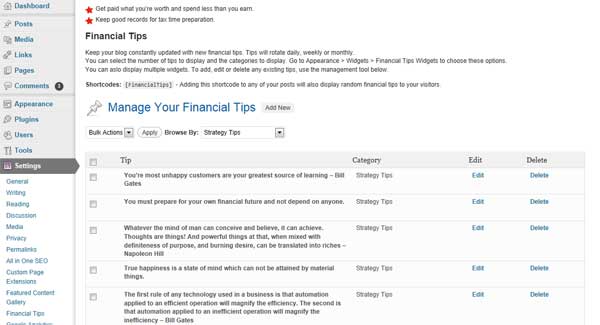
Coolchecks.net has created a WordPress Plugin that bloggers can use on their financial WordPress websites. The plugin displays a list of financial tips taken from a variety of financial experts. Each tip was chosen to help readers learn about important financial concepts and goals. There are three areas the tips appear in: the sidebar, the admin panel and there is a short code you can use to add to your posts.

The user can choose how frequently the tips should be rotated, either daily, weekly or monthly. Users can also create their own tips customized to fit their audience. This customization helps to give a unique branded message that is constantly changing and keeps readers wanting to come back to read updated content.

Our focus for this plugin is to educate and inform others about good, sound financial principles that will help them with their personal financial goals. If you have a personal finance site that needs new content, then be sure to try this new widget. It is free to use and hopefully will interest your audience.

Download Financial Tips Plugin here. Then unzip the file and upload the folder to your wordpress plugin directory. Activate the plugin.

Financial Tips Plugin

The screen shot above shows the management page of the plugin. This is where can edit any existing tips or add your own tips.

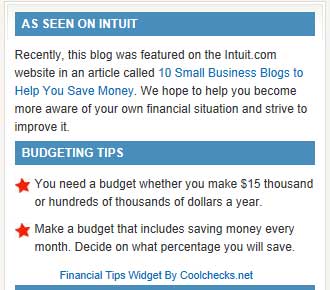
Side Bar Text Widget

The text widget can rotate your tips on a daily, weekly or monthly basis. You can also select how many tips to show and choose you the category you want. You can use more than one widget.

Please let us know if you have any trouble with getting the plugin to work for you or if you have any suggestions to make it better! To a bright outlook on your wealth building future!

Filed Under: Personal Finance Tagged With: money management, Personal Finance, WordPress

  • « Go to Previous Page
  • Page 1
  • Interim pages omitted …
  • Page 12
  • Page 13
  • Page 14
  • Page 15
  • Page 16
  • Go to Next Page »

Primary Sidebar

Personal Finance Articles

  • Make Saving A Priority
  • Review Your Home-Insurance Risks
  • Lowest Air Fare? Try August 28
  • Hackers Targeting Bitcoins
  • Keep Your Emergency Fund Intact

Save At Walmart

Search

Personal Finance Education

Investing Education from Morningstar.

As Seen On Intuit

Intuit.com has ranked Coolchecks.net #4 out of 10 of the best blogs to help you save money. We hope to help you become more aware of your own financial situation and strive to improve it.

Featured On Mint.com – July 2014

Mint Interview

Categories

  • Banking
    • Check Writing
    • Checking Accounts
    • Credit Cards
    • EMV Cards
    • Fees
    • Fraud
    • History
    • Student Loans
  • Best Of The Web
  • Budgets
    • Emergency Fund
    • Grocery Shopping
    • Saving Money
    • Spending Habits
  • Business
    • 3D Printing
    • Bankruptcy
    • Business Advertising
    • Business Development
    • Business Plans
    • Corportate Lessons
    • Data Mining
    • Legal Issues
    • Merchants
    • SEC
    • Security
    • Small Business Startups
  • Consumer Alerts
  • Cryptocurrency
  • Cutting Costs
  • Employment
    • best places to work
    • Careers
    • Interviews
    • Job Search
    • Top CEOs
    • Wages
  • Entrepreneurs
    • Attitudes
    • Entrepreneur Interviews
  • Featured
  • Finance
    • Automobiles
    • Credit Ratings
    • Education
    • Financial Planners
    • Foreclosures
    • Homes
    • Insurance
    • Investing
    • Mortgages
    • Personal Finance
    • Renting
    • Term Deposits
    • Travel
    • Work
  • Fraud
  • Government
  • Holidays
    • Christmas
    • Halloween
  • Internet
    • Bitcoin
    • Blogging Tips
    • Blogs, RSS and Podcasting
    • Databases
    • Facebook
    • Influence
    • marketing
    • Twitter
    • Website Reviews
    • WordPress
      • Key Words
  • Investing Basics
    • Hedge Funds
    • Investing
    • Mutual Funds
  • Life
    • Aging
    • Just For Fun
      • Punahou Alumni Corner
    • Millennials
    • Personal Health
  • Money Making Ideas
    • Affiliate Programs
    • Craigslist
    • Ebay
  • Money Management
    • Bankruptcies
    • Building Wealth
    • Child Care Costs
    • Christmas Shopping
    • Credit
      • Free Credit Report
    • Debit Cards
    • Debt
    • Debt Reduction
    • Health Insurance
    • Income
    • Inheritance
    • Interest Rates
    • Loans
    • Mortgages
    • New Years Resolutions
    • Retirement
    • Shopping Tips
    • Tax Strategies
    • Your Stories
  • Retirement
  • Self Improvement
    • Time Management
    • Work Habits
  • Shopping
    • Coupons
    • Online Shopping
  • Social Security
  • Tax Tips
  • Taxes
  • Technology
  • Trade
  • Uncategorized
  • Wealth

Best of Personal Finance Blogs

Best of BuyerZone Business Finance Blog Recipient

Personal Finance Sites We Recommend

Get personal finance advice from the people behind the top money blogs, including Wise Bread, The Simple Dollar, Mint and Nerd Wallet.

Copyright © 2026 ·Metro Pro · Genesis Framework by StudioPress · WordPress · Log in