• Skip to primary navigation
  • Skip to main content
  • Skip to primary sidebar
  • Money Management
    • Debt Reduction
    • Credit
    • Mortgages
    • Mutual Funds
    • Tax Strategies
    • Loans
  • Budgets
    • Saving Money
    • Income
  • Banking
    • Checking Accounts
    • Check Writing
    • Fraud
    • History
  • Entrepreneurs
    • Entrepreneur Interviews
    • Money Making Ideas
    • 3D Printing
  • Resources
  • Retirement
  • About
    • Privacy Policy

Personal Finance Blog

Tips And Stories To Help You With Managing Money

  • Privacy Policy
  • Saving Money In 2018
You are here: Home / Archives for Money Management

Money Management

Mortgage Rates Are Down

May 12, 2014 By Twila Van Leer

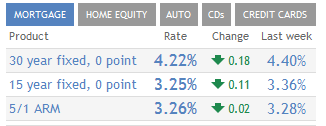
mortgage-ratesAnyone who has ever ventured into the world of home buying has learned something about the interest rates that are an integral part of the deal. They yo-yo up and down almost daily. In early May, they hit the lowest level they have been for awhile, at 4.21 percent for a 30-year fixed rate house loan. That was a decline from 4.29 percent the previous week. For a 15-year loan the rate 3.32 percent, a drop from the 3.38 percent of the previous week. The 15-year option is popular for those refinancing existing mortgages.

These rates were the lowest since last November.

The question for most lay folk not privy to the ups and downs of the housing market, the question is: What causes the swings? Why do they rise and fall so consistently and so fast?

Believe it or not, such things as global unrest and a weak U.S. economic recovery from the recent recession are major factors. What happens in Africa and Russia and China sends shock waves into the American economy and affects transactions at the most basic levels. The old saying that it’s a small world is especially true when it comes to the fluctuations in the American housing market.

Negative economic effects in other places on the globe contribute to the ongoing bid for Treasury debt, which drives yields down, with a subsequent dip in mortgage rates as well, financial gurus say. That’s good news for those in the market for a home. The practical effect is a lower house payment. For instance, on a $200,000 home with a 30-year fixed rate mortgage, the monthly payment would be $979 a month at rate of 4.21 percent. At the norm of 6 percent, the home buyer could expect to shell out about $1,200 per month. Though the fractional increases or decreases in the interest rate seem negligible, they make a big difference when you’re making a long-term loan.

There are, of course, other factors at play. Stricter lending standards have to some extent limited the impact of the lower interest rates, according to data compiled by the National Association of Realtors. A high credit score can even the effect. But for those with lower scores, credit is still very tight, the association reports. Many of those who would like to jump into the housing market can’t find financing, despite the attraction of a lower interest rate.

The best solution for those whose credit is marginal is to work on improving the credit score to make themselves more appealing to those who made loan decisions.
Filed Under: Credit, Mortgages Tagged With: Credit Scores, mortgage loans, Mortgages

Women Today Earn Nearly Three Times What Their Mothers Did

May 5, 2014 By Twila Van Leer

"More women are in the labor force now than a generation ago, and they are working longer hours and earning more money than mothers did."
“More women are in the labor force now than a generation ago, and they are working longer hours and earning more money than mothers did.”

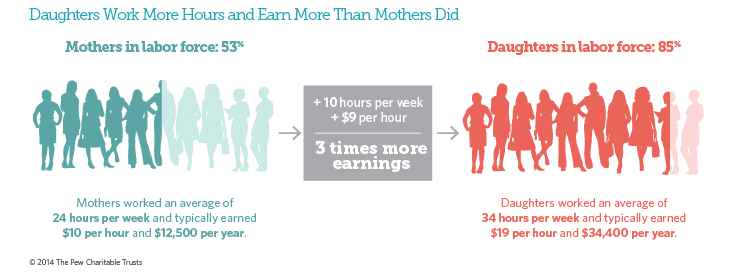
Today’s working woman probably makes three times what her mother did. But they don’t earn on par with their dads, or their brothers. So the male component retains the more frequent breadwinner status, with the female members of the families supplying supplemental income.

A study by the Pew Economic Mobility Project compared what women who were about age 40 earned in the late 1960s and early 1970s earned, in comparison with their daughters in the same age group in the 2000s.

“Increases in hours worked and wages translate into higher annual
earnings: Women today earn nearly three times what mothers did.”

The research showed that a higher percentage of women work today and they work longer hours at higher wages. Four times more women work outside the home now than did in the earlier time frame. Men’s jobs suffered more in the Great Recession, making women’s income more important to the family’s well-being.

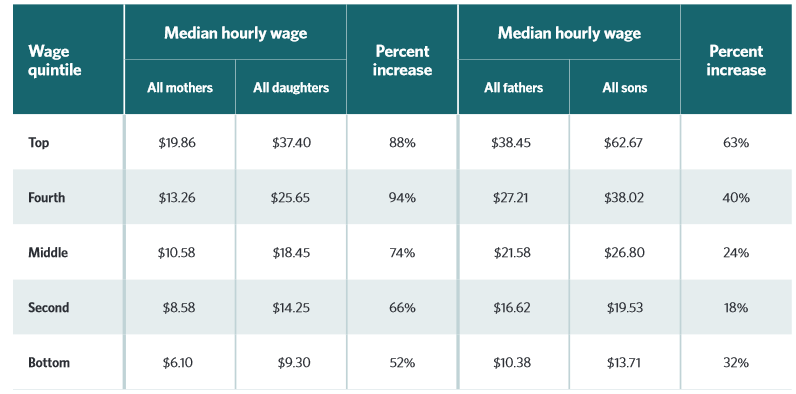
All wages are adjusted to 2009 dollars. Daughters’ and sons’ characteristics are measured from 2001 to 2009 and mothers’ and fathers’ from 1968 to 1972.

At every income level, today’s women outstripped their mother’s earnings by at least 50 percent, the project learned. The wage differential between fathers and sons was lower, but the sons emerged as the group that leads in earnings.

Daughters have made big advances, but in comparison with their dads, are still at the bottom of the earnings ladder. Their per-hour income is less than Dad’s was thirty years ago, the study showed. Women leaving the workforce temporarily or permanently to be mothers accounts for some of the difference.

The Pew researchers, however, look ahead to trends that show the wage differences will continue to shrink. Women are graduating from college at higher rates now than men. The wages of the youngest women in the sampling are more on a parity with their male peers, assuring that their financial contributions to their families in the future will be even more important.

Filed Under: Income Tagged With: Income

Debit Card Pre-Authorization Holds

February 3, 2014 By Twila Van Leer

You insert your debit card. You pump the gas. You cringe (the current average price- per-gallon for premium is $3.62) and you leave the filling station assuming the $40 total will be subtracted from the balance in your debit card account. Simple, right?

What you don’t know is that behind the scenes, computers are doing their thing and when they are done, your bank may have put a pre-authorized hold on your account. It may be larger than your actual balance, especially if you are chronically hovering about the edges of the account. That means that when you drive from the gas station to the grocery store, your $15 purchase there may not be covered by the debit account.

For example, this made-up scenario: You have $100 in your account balance. You purchase $80 worth of merchandise or services (restaurants and hotels may also use this approach, as well as gas stations). The bank puts a pre-authorization hold on your account for $80. So the $20 you thought you had in the account is not available and additional use of the card will not be honored, which could mean additional fees.  Some credit card users have found themselves in serious trouble with overdrafts, not to mention the embarrassment and inconvenience involved.

In essence, your “available” balance and your “actual” balance can be two different figures.  The amount of the hold is deducted from your accounts “available” balance but not from the “actual” balance until the transaction that triggered the hold is processed, which could be several days.  Paying attention to your  “available” balance will help, but given the time frames involved, may not always provide the needed information as quickly as necessary.

“I don’t think the average customer has any idea what goes on behind the scenes when they swipe a card,” said Jeff Lenard, vice president of communications for the National Association of Convenience Stores (which sell about 80 percent of the gasoline purchased in the United States each year.)  “The credit and debit card system is incredibly complex.”

The problems associated with pre-authorized holds are only part of the potential trouble with using cards for gas station transactions.  Financial gurus also point out that the stations are a “danger zone” for theft of card data for fraudulent uses. Julie McNellely, senior analyst for Aite Group, a Boston-based financial services research organization, describes how bad guys bent on fraud use the stations to achieve their ends.

While customers are using their debit cards to make purchases at the pump, a thief sitting in a car nearby, armed with a laptop, a pinpoint camera and an antenna, has skimmed off the vital information from the card, including, if the camera is able to get a good view, the PIN. Before the unwary customer has even arrived at home, the information may have been put to fraudulent use.

Experts familiar with the potential for fraud at the gas station suggest the use of cash or credit cards, rather than debit cards, when filling up.

Filed Under: Debit Cards Tagged With: debit cards

Take a Good Look Before Refinancing Your Mortgage

January 31, 2014 By Sherry Tingley

Thinking about refinancing your mortgage to pay off credit card debt? Don’t jump too fast. There are factors that make such a financial leap a very bad idea.

credit-card-trapOn the face of it, it seems a good idea to swap “bad” credit card debt for an extension of your mortgage, which is generally viewed as “good” debt. Among the arguments people use when making such a decision is the fact that mortgage interest is tax-deductible, while credit card interest — usually much higher, climbing up to 30 percent in some instances — is not. In fact, long experience shows that making such a change is seldom a wise step.

Trading Unsecured Debt For Secured Debt

The most compelling reason you should not exchange mortgage debt for credit card debt is that you are converting unsecured debt (the credit card balances) for secured debt. A credit card company doesn’t ask for security, only your word that you will pay the debt. If you fail to pay, you could conceivably be sued, although most credit card companies don’t go to that extreme unless your balances are very large. The company could put a lien on your home, but typically it could not force you to sell.

With a mortgage, your house becomes collateral for the loan. The lender has a security interest in your home.

Loan Costs

Refinancing is not free. You’ll likely have to pay for an appraisal and possibly a home inspection, as well as loan origination fees and closing costs. The cost will depend on your credit score, your mortgage lender and the amount of the mortgage. In 2008, the Bankrate Survey determined that closing costs to refinance a $200,000 home amounted to an average $3,118. Those costs may to a degree offset the costs of high interest rates on credit cards.

Longer Time To Repay

Refinancing extends the time you will be obligated to discharge a mortgage (and the credit card debt you have added to the mortgage.) In reality, you are only extending the life of the credit card debt to the mortgage. That may mean it stays with you for the usual 15- to 30-year term of the mortgage. It is possible you will end up paying more interest than if you chose to plug along and pay off the credit card debt as you are able.

Credit Score Damage

A refinance may damage your credit score. It will trigger a new inquiry on your credit report by shortening the average or y our accounts. The companies that do credit reports will note the higher mortgage and be nervous, particularly if the level or your income is marginal. The impact may be short-term, especially as large-balance credit card debt will no longer show up in the reports, but there will be some impact.

Difficulties Selling Your Home

Selling your home may become more problematic if there are additional mortgages. To sell, you must pay off the balance of the mortgage burdens, and most likely pay a real estate commission of up to 6 percent. Banks typically won’t let you refinance a home unless the anticipated mortgage amount is below 80 percent of the home’s value. And be aware that home values tend to respond to financial vagaries and can fall fast. Having to sell under pressure because of such situations as a new job location might force you into missing the optimum return for your property.

Little Changes Made In Decreasing New Debt

Too many people who use a mortgage refinance to resolve credit card issues don’t overhaul their budgets and change their spending habits to avoid racking up more debt. They pile debt upon debt at an increased risk of losing their home because the mortgage payment is now higher and there are fewer options available. A genuine commitment to avoiding credit card debt is essential to getting any benefit from a refinance.

Solutions

Better alternatives for dealing with high-interest debt include debt settlement, debt consolidation and  even bankruptcy. Putting your home at risk should be a last resort.

Related articles across the web

  • Debt Management: Save or Pay Down Debt

Filed Under: Credit, Finance, Money Management, Mortgages Tagged With: Debt, Mortgages

Managing Credit Is Essential

November 19, 2013 By Twila Van Leer

The successful financial management of a household in a day of easy credit depends to a large degree on controlling the credit load you acquire. The amount of money being paid on credit card debt compared with income is a critical figure that household managers often don’t know, or simply ignore and it can lead to financial disaster.

Figures compiled by government overseers show that in 2001, 11 percent of all American households had debt that was using up more than 40 percent of their income. The ratio is even greater in low-income families, which have a greater tendency to use credit when cash is short. The 2001 study was conducted by the Survey of Consumer Finances, an arm of the Federal Reserve. Results indicated that 7 percent of all the households contacted had a payment at least 60 days overdue. Only 45 percent of the credit card-holding households surveyed did not carry over a balance on their accounts.

Using some smarts at the beginning of the credit card pipeline pays. But even this common sense approach often is overlooked. Only a third of those who responded to the survey said they compared the many offers being made to potential credit card holders before acquiring a card.

The low figures may reflect how individuals view credit purchasing in the overall management of their resources. Those who simply use credit as a convenience in purchasing, with no intent ever to have a balance, may see no need to compare. Even so, it pays to look at the fees, terms and special features of the many credit offerings.

The level of financial knowledge in a household often mirrors how finances are managed. The survey found that lower levels of knowledge often correlated directly with less efficient handling of credit debt.

Debt management and savings also had direct correlations. Families that had control of debt payment also were more likely to make regular payments into a savings account. Four-fifths of all the families surveyed reported a savings account, but fewer than half of these made regular contributions to their savings out of each paycheck.

Maintaining an emergency fund to cushion against financial shocks also tied sound credit management to being prepared. Many studies, including those done by the Federal Reserve, consistently show that more than half of the country’s households are unprepared, even for a moderate period of unemployment. Again, general understanding of financial principles lagged in those families least prepared.

Planning ahead for such things as vacations, college expenses, medical needs, replacement of vehicles and other large-tag items also should be considered when credit use is a factor. One area that should call for some particularly thought is the prospect of retirement. A third of those surveyed did not know how much they needed for reasonable retirement and many who had looked ahead were far short of the amount financial experts suggest.

The survey emphasized the need for making credit buying a significant factor when analyzing family finances across the board. And it definitely made a strong connection between knowing about finances and managing them. That can be taken as a word to the wise.

Filed Under: Credit

  • « Go to Previous Page
  • Page 1
  • Interim pages omitted …
  • Page 28
  • Page 29
  • Page 30
  • Page 31
  • Page 32
  • Interim pages omitted …
  • Page 43
  • Go to Next Page »

Primary Sidebar

Personal Finance Articles

  • Make Saving A Priority
  • Review Your Home-Insurance Risks
  • Lowest Air Fare? Try August 28
  • Hackers Targeting Bitcoins
  • Keep Your Emergency Fund Intact

Save At Walmart

Search

Personal Finance Education

Investing Education from Morningstar.

As Seen On Intuit

Intuit.com has ranked Coolchecks.net #4 out of 10 of the best blogs to help you save money. We hope to help you become more aware of your own financial situation and strive to improve it.

Featured On Mint.com – July 2014

Mint Interview

Categories

  • Banking
    • Check Writing
    • Checking Accounts
    • Credit Cards
    • EMV Cards
    • Fees
    • Fraud
    • History
    • Student Loans
  • Best Of The Web
  • Budgets
    • Emergency Fund
    • Grocery Shopping
    • Saving Money
    • Spending Habits
  • Business
    • 3D Printing
    • Bankruptcy
    • Business Advertising
    • Business Development
    • Business Plans
    • Corportate Lessons
    • Data Mining
    • Legal Issues
    • Merchants
    • SEC
    • Security
    • Small Business Startups
  • Consumer Alerts
  • Cryptocurrency
  • Cutting Costs
  • Employment
    • best places to work
    • Careers
    • Interviews
    • Job Search
    • Top CEOs
    • Wages
  • Entrepreneurs
    • Attitudes
    • Entrepreneur Interviews
  • Featured
  • Finance
    • Automobiles
    • Credit Ratings
    • Education
    • Financial Planners
    • Foreclosures
    • Homes
    • Insurance
    • Investing
    • Mortgages
    • Personal Finance
    • Renting
    • Term Deposits
    • Travel
    • Work
  • Fraud
  • Government
  • Holidays
    • Christmas
    • Halloween
  • Internet
    • Bitcoin
    • Blogging Tips
    • Blogs, RSS and Podcasting
    • Databases
    • Facebook
    • Influence
    • marketing
    • Twitter
    • Website Reviews
    • WordPress
      • Key Words
  • Investing Basics
    • Hedge Funds
    • Investing
    • Mutual Funds
  • Life
    • Aging
    • Just For Fun
      • Punahou Alumni Corner
    • Millennials
    • Personal Health
  • Money Making Ideas
    • Affiliate Programs
    • Craigslist
    • Ebay
  • Money Management
    • Bankruptcies
    • Building Wealth
    • Child Care Costs
    • Christmas Shopping
    • Credit
      • Free Credit Report
    • Debit Cards
    • Debt
    • Debt Reduction
    • Health Insurance
    • Income
    • Inheritance
    • Interest Rates
    • Loans
    • Mortgages
    • New Years Resolutions
    • Retirement
    • Shopping Tips
    • Tax Strategies
    • Your Stories
  • Retirement
  • Self Improvement
    • Time Management
    • Work Habits
  • Shopping
    • Coupons
    • Online Shopping
  • Social Security
  • Tax Tips
  • Taxes
  • Technology
  • Trade
  • Uncategorized
  • Wealth

Best of Personal Finance Blogs

Best of BuyerZone Business Finance Blog Recipient

Personal Finance Sites We Recommend

Get personal finance advice from the people behind the top money blogs, including Wise Bread, The Simple Dollar, Mint and Nerd Wallet.

Copyright © 2026 ·Metro Pro · Genesis Framework by StudioPress · WordPress · Log in