Dealing With Trial Periods
June 8, 2009 by Personal Finance Blogs
Filed under Finance
Comments Off
Let’s face it, we live busy lives. I’m pretty sure that most companies are aware of this. I’m also pretty sure that that’s why many companies entice customers with trial periods. Think about it. How many times have you signed up for a service because it was free for 3 months, with the real intention of canceling said service at the end of the trial period, only to forget to call and actually cancel the service? Having figured out that many customers will forget to call and cancel, companies can afford these trial periods, banking on the busyness of the average consumer.
Personally, I’m very busy. So, when I’m offered a trial period, especially one that requires a phone call in order to cancel a service, I’m vary wary. In most cases, I simply decline the service. This is by far the easiest way to deal with most of these types of offers.
Once in a while, however, I’ll actually get an offer to try a service that I’m actually wanting to check out. For instance, I recently switched satellite television providers, and enjoyed three months of free premium movie channels. Just last night, I called my provider, just as the free trial period ran out, and canceled the channels. It was fun to have the channels, but I really do not need them.
If, like me, you struggle to stay organized, but you still want to take advantage of these trial periods, consider setting up a reminder system. Personally, I use the iCal program on my computer, and make a simple note, reminding myself of when to call and cancel a particular service. I also know folks who use websites like FutureMe, a website that will allow you to schedule a reminder email, and send it to yourself at a specific time in the future. Pretty rad.
Remember, before signing up for any free trial period, be sure that you know exactly how to cancel the service. This is especially true for services offered by credit card companies and credit reporting services. Taking the time once a month to take care of these pesky little phone calls can, in the long-term, save you a lot of money.
Follow me via Twitter

[TheSimpleDollar] Insights into Saving Psychology from The Economist
June 7, 2009 by Personal Finance Blogs
Filed under Finance, Saving Money
Comments Off
Recently, while digging through the magazines in our magazine rack, I came across the May 16, 2009 issue of The Economist. The Economist is my primary print source for news and it almost always gives me quite a bit of food for thought.
Anyway, on page 82, I found a really interesting article entitled “Smooth Operators,” which discusses some very savvy saving techniques that have developed in nations with developing economies. First, though, is a bit on why such techniques are needed there:
Paying interest on your savings will strike most people as odd. Yet some poor people in the developing world do just that. In West Africa, for example, some people pay roving susu collectors a fee amounting to a -40% annual interest rate for looking after their deposits. [...] a similar phenomenon in India, where a female deposit collector named Jyothi looks after small savings for people in the slums of Vijayawada at an effective yearly interest rate of -30%.
To us, this seems very alien. Why would you bother to put money in a savings vehicle if you’re charged such outrageous fees?
To put it simply, money security is the real reason. Keeping significant amounts of cash on hand can be dangerous, and after doing a risk assessment, it’s pretty clear that to many of these people, it’s better to pay that painful fee than risk the high likelihood of having the money taken in some method – a -100% interest rate is far worse than a -40% interest rate.
But why save at all?
Many of the subjects emphasized [that] controlling the flow of cash becomes all the more critical when income is not just low, but also unpredictable and irregular.
In other words, many of the people using these savings systems have very irregular incomes, so in order to survive during the many lean times, they need to sock money away. And without personal security, they need a service that keeps the money safe, so they utilize the susu (and other local variants).
It’s not that different than the problems that people face in America, where many people have irregular incomes (I myself am one of them). To put it simply, if your income is irregular, you have to save. You can’t spend what you earn, or else you’ll be in deep trouble during the lean times.
What gets interesting, though, is some of the tactics the savers use.
They are acutely aware, for example, of the importance of some psychological phenomena whose effects behavioural economists have only recently begun to explore. For instance, they purposefully seek out commitments to help ensure that they meet their savings goals. Many of the South African women in the study joined several monthly “savings clubs” in spite of having bank accounts. They found that the extra discipline the clubs provided was valuable in itself, because it compelled them to save no matter what.
This is a really important point, one I think is overlooked in western society. Peer pressure is a huge motivator, and using it for savings goals pushes you strongly towards saving. The idea of a “savings club” seems a bit strange, but why not? Investing clubs are quite prevalent in the United States, and they have roughly the same goal – encouraging people to invest and keeping their eyes on the prize.
If you have some friends that are also trying to save for different goals, why not start a savings club? Meet once a month or so to talk about money saving tactics and to share your progress. Knowing that you have to tell the others in the club about your progress will push you to meet the goals you’ve set, lest you look bad in their eyes.
Another solid tactic comes later in the article:
The mother of a Bangladeshi man who found himself unable to stick to his monthly saving goal found she could make him save more by taking out a loan from a microfinance company. The shared obligation of having to pay the regular loan installments meant he abandoned his spendthrift ways.
At first, this might not seem like the best idea. Taking on debt to force yourself into regular savings behaviors?
But think of it from their perspective. That microloan might have a 10% interest rate. On the other hand, the susu down the street charges you 40% interest on your savings. Seems like a good deal to me.
This is not altogether different than when people play games with 0% balance transfers on credit cards. They write a cash advance check from card A into their savings account, then do a 0% balance transfer from card B to card A to cover that check. Then they hold the cash in their savings, earning 2-3%, until they have to pay back the 0% transfer. Along the way, they can usually earn a few bucks, particularly if the amount isn’t large enough to really harm their credit.
In both cases, it’s a crafty way to use the financial tools available to you in an unexpected way to put yourself in a better financial place. Don’t just think of a credit card as a way to buy more stuff. Don’t think of a low interest or a zero interest loan as bad simply because it’s debt. Instead, look at all the tools available to you – and use them together to maximize your situation.
Personal finance lessons can come from anywhere. Always keep your eyes open.
Buying Something to Force Yourself Into a New Behavior Doesn’t Work: New Rules for a New Routine
June 6, 2009 by Personal Finance Blogs
Filed under Finance
Comments Off
Several people I know have a treadmill in the garage or basement of their home. They bought it with great visions in their head of walking every day, but after the newness wore off, the treadmill began to gather dust – then it was folded up and put into storage.
One reader of The Simple Dollar invested almost $1,000 in pans for her kitchen. Six months later, she’s still mostly using the microwave and the pans are gathering dust.
One of my friends bought a netbook recently, thinking she’d use it all the time to keep up with her email better for her online business. It’s still in her purse, but she claims to have only used it three times in the last month. Instead, she still uses her cell phone.
I myself have done this. Take Wii Fit, for example. When I bought it, I thought it’d be great for establishing a simple cardio exercise routine. I do use it, but instead it just comes out once a week to play mini-games on.
Each of these purchases is essentially the same story. You have a behavior you want – a fitness routine, cooking good food at home, keeping more up-to-date with email – but you’re having some difficulty establishing it. So you make a big, splashy purchase in order to kick-start things – and then you find that didn’t do the trick either, and you’re left with a lot of money sunk into something you don’t really need.
Many people have stories like this (in fact, share yours in the comments!). Why is it so prevalent? I think there are at least three reasons.
First, we have the best of intentions. Most of us do actually strive to improve ourselves, but lives are complicated. Almost every moment is a balance of different things – the things we want to do, the things we should be doing, and so on. It’s often hard, even with the best of intentions, to push another routine in there, especially a time-intensive one.
Second, advertising appeals to those intentions. We see ads for exercise equipment, think about our goals, decide that “we could do that for twenty minutes a day,” and order the equipment. A good ad is designed to do that – prey on a notion already in our head and transform it into a purchase.
Third, a new routine is perilously hard to establish. You have to make yourself do it every day, at least for the first month or two. It doesn’t come naturally.
Add these all up, and buying a piece of equipment in order to jump-start a new routine is almost always a complete waste of money.
Instead, I propose some new rules for a new routine.
First, figure out a very simple routine – don’t dive in with a complex one. Walk for fifteen minutes a day. Practice the guitar for fifteen minutes. Cook one meal a day – and keep it a fairly simple one. Check your email three times a day. Check Twitter three times a day.
Second, try establishing the routine with minimal equipment. Don’t go buy a treadmill or new running shoes. Instead, go outside and walk every day for fifteen minutes – go around the block three times or so. Don’t go buy a netbook – instead, try checking your email on the equipment you already have. Don’t go buy $1,000 worth of pans – instead, buy one low-end pot and one low-end skillet and try making some very simple dishes every day. Don’t go spend $3,000 on an electric guitar – get an old acoustic one to practice on and see if it sticks.
Third, make room for the new routine. In other words, find an unhealthy routine and minimize it. Cut your television viewing down to an hour a day – or less. Trim down your internet usage if you use it excessively. Stop going out to eat so often – cut it down to once a week. All of these choices free up time – and that free time can easily be filled by your new routine.
Finally, make reminders. Leave your equipment out where you can’t miss it. Put your guitar in your favorite chair. Sit your jogging shoes there. Keep your pans right out on the stove. Leave recipes out where you can find them. In short, make your new routine screamingly obvious at all times, giving you the best chance possible to make the leap to maintain it.
Good luck on the new routines in your life.
The Simple Dollar Time Machine
June 6, 2009 by Personal Finance Blogs
Filed under Saving Money
Comments Off
From [TheSimpleDollar]
Many newer readers of The Simple Dollar haven’t been exposed to the hundreds of great articles in the archives of the site, so this is a weekly series that highlights the five best posts from one year ago this week, as well as the five best posts from two years ago this week. I call it … the Time Machine.
One Year Ago (May 31-June 6, 2008)
Planning for the Long Haul: My Family’s Lifetime Financial Plan We’re still pretty much sticking to this plan a year later. Nothing has really changed, except for, to some extent, the “retire early” part, since we’re both passionate about our work. We’re also on track for our 2009 goal.
Money Magazine’s “7 Investments You Need Now,” Portfolio Theory, and My Own Plans for the Future A mixture of railing against the “fund of the month” type of financial writing along with how to translate it into something truly useful, as well as a primer on basic portfolio theory. Mmm… a tasty mix!
Making Frugality a Game For people who thrive on competition, this is one way to make frugality really work in your home.
Got Credit Card Debt? Ten Tactics to Use Right Now to Get It Under Control If you’re sitting there with a big mountain of credit card bills and you’re simply wondering where to go from here, here’s ten things you can do immediately to start taking charge of the situation.
Ten Clever Money Savers You Might Want To Try This Weekend Some of these are really timely, because they focus on tactics that work great in June but perhaps don’t work well in November.
Two Years Ago (May 31-June 6, 2007)
Ten Financial Matters I Wish I Had Discussed With My Wife Before We Got Married This is a pretty good list of things for any couple to discuss, particularly during the run-up to marriage, but also afterward. My wife and I would have started our marriage on a better foot with these conversations.
Comparing Yourself To An Earlier Generation – And Blowing The Comparison To Bits The financial reality of your generation is different than the ones before it – and the ones after it, for that matter. Don’t judge your success by what your parents did at a similar age – and don’t judge your children’s success by where you were at their age.
Save Time, Effort, And Money With A Monthly Home and Auto Maintenance Checklist If you own a home or an automobile, it’s well worth your while to spend an afternoon once a month practicing proper maintenance. Things will last longer and you will save money – a lot of it. Here’s a lengthy checklist to get you started.
The Simple Dollar Convinces Someone to Quit Their Job This was actually the very first moment when I realized that the things I wrote really impacted people’s lives. It was exciting, but simultaneously quite scary.
A Guide To Eating Well Without Spending A Fortune Although we spend more on food than we should, it’s primarily because we buy things like organic milk and free range chickens. Our baseline of food spending is actually really low, and here’s how we do it.
If you’d like to browse through more of the archives, visit the chronology, where all posts are listed in chronological order.
Eight Ways to Get More out of The Simple Dollar
This is kind of a FAQ for new readers and is posted each week along with the Time Machine. Here are eight great ways for new readers to dig deeper into The Simple Dollar.
1. Subscribe by email or RSS. Visiting The Simple Dollar’s website is great, but for many people, it’s more convenient to receive the articles in another form. It’s easy to join 60,000 other subscribers and get The Simple Dollar’s content by email or in your RSS feeder (if you’re unfamiliar with RSS, check out Google Reader.
2. Comment. Each article on The Simple Dollar has lively discussion. Just click on the green square in the upper right of each article on the website and join in!
3. Read my story of financial meltdown and recovery. The Simple Dollar isn’t based on what I’ve read in books or learned in school. I’ve made a lifetime of financial mistakes – The Simple Dollar is a record of what works for me during the process of getting my life on a better track.
4. Download my free 49 page e-book. Everything You Ever Really Needed to Know About Personal Finance On Just One Page is completely free. It summarizes all of the key lessons I’ve learned along the way about personal finance in one tidy package – in fact, all of the main principles can be found right on the cover.
5. Follow me on Twitter. I post tons of interesting articles, quotes, follow-up material, commentary, and other material on Twitter. Follow me! If you’re unfamiliar with Twitter, it’s essentially an open discussion forum for people to share ideas and thoughts with other like-minded folks – you just choose the people you want to listen to and their ideas and thoughts are all delivered to you on a single page.
6. Dig through “31 Days to Fix Your Finances.” 31 Days to Fix Your Finances is an article series that outlines how you can get a grip on your finances over the course of a month.
7. Send me your questions and suggestions. Send me an email and let me know what you’re thinking, what you’d like to see, and any questions you might have. I try to respond to as many emails as possible and I read them all. I may even use your question in a future article!
8. Email a great article you find to a friend. Find an article that you think your friend would love? At the bottom of each article, you’ll find a link that says “Email this” – just click on that, type in your friend’s address, and send it right along to them!
Living and Saving in the Moment
June 5, 2009 by Personal Finance Blogs
Filed under Budgets
Comments Off
My three year old son loves to go to the grocery store with Mom and Dad. He wanders around with us, listening to our discussions about which products to buy, and quite often expresses his own opinions. He’ll remind us that he loves V8 Fusion (our preferred fruit juice, since it’s 100% and also is half vegetable juice) and often dallies for a long time near the Pepperidge Farm goldfish crackers, as I noted two years ago (and depicted as well):

As we shop, we make tons and tons of little decisions along the way. Those decisions, on their own, seem inconsequential.
Should we buy the bulk can of diced tomatoes or the smaller can?
These tortillas feel softer, but they’re way more expensive – is it worth it?
The free range whole chickens are on sale! Should we stock up?
A choice one way or another here might save us a dollar or cause us to spend a dollar more. In the eyes of many people, it’s an inconsequential decision – just make it and keep going. One dollar doesn’t make a huge difference, right?
The problem is that each little buying decision you make is deeply tied to other buying decisions, whether consciously or not.
How so, you might ask?
All of our buying decisions are based on a set of principles in our head, ones that are often so well-grounded that they don’t even pop up in conscious thought.
Here’s a thought experiment to help you see what I mean. Imagine a product you would never buy in a grocery store – pork rinds, maybe, or perhaps insanely potent hot sauce. Now, what about that product would cause you to not buy it? You’re likely to pop up an immediate simple answer – I don’t like the taste or it’s unhealthy – but on other purchases, you’re quite willing to overlook that principle for other reasons.
In truth, when we make a decision to buy in the grocery store, we’re trying to reduce a big set of principles and inputs down to one split-second decision. And often we feel we’re completely justified in that decision – and we move on with life.
It is very easy to tease apart each little buying decision, tell yourself that it doesn’t really matter that much and that it’s okay to splurge, and then essentially ignore your final tally when you get to the checkout because each decision was justified in your mind. Doing that, though, is a game that will, time and time again, put your wallet in the hurt locker.
So, what can you do to overcome this problem?
The easy methods are the shopping list and the meal plan. Making a shopping list in advance of your visit to the grocery store simply serves to reduce the number of decisions you have to make. This, of course, leads you to making fewer bad decisions.
But that’s just the start. Once you’re in the store with your shopping list in hand, commit to three more things.
First, simply do not put anything in your cart that’s not on your list. Your list, if it’s thought out at all, should have everything you need for your meals for the next week. If you see something you feel like you need or deserve, jot it on the back of the list for next time.
Second, mark any items that you’re not simply searching for the cheapest version of. On our list, I like to put a little X by any item that I don’t intend to just buy the cheapest version of. For example, with diced tomatoes, the various brands and cans are identical in terms of ingredients, so we usually just get the cheapest version. This, again, reduces the number of opportunities for poor impulse decisions in the store.
Third, if you have specific brands in mind (because of coupons or because of previous buying experiences), put those on your list, too, along with the size. For example, we usually have a big stack of coupons for V8 Fusion (100% juice, half fruit and half vegetable). So, instead of just writing “fruit juice x 3,” I’ll write “46 oz. V8 Fusion x 3? on the list. In other words, if you make the list more specific, you further reduce the number of potential impulse decisions in the store.
Using all of these techniques, you’ll end up making just a handful of in-the-moment choices in the grocery store – and with fewer potential decisions, you have fewer chances to make poor ones. The end result? A cart full of items that you actually want and a much smaller grocery bill.
How to Use TweetDeck To Help You Twitter
June 4, 2009 by Sherry Tingley
Filed under Twitter
Learning how to use Twitter is easy for some people, but for others, it is a struggle. If you sign up for a twitter account at twitter.com, you can easily see how to use Twitter, but you might wonder how you can possibly manage following more than ten people.
Actor Anderson Cooper was on the Kelly and Regis show this morning discussing twittering. Not only were they discussing twittering, he was twittering during the show. Kelly Ripa admitted she doesn’t Tweet. I think it’s time now that she learns how to twitter. Anderson not only is a twitter fan, but has 221,110 people following him. He actually used his phone to twitter during the show.

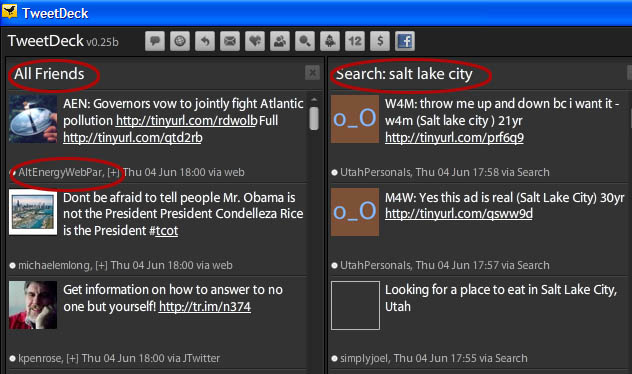
Twitter applications have been developed to help you manage your twitter friends. I’ve read and heard about a lot of applications, but the one I like the best is called TweetDeck and you can download it from TweetDeck.com. To the left you will see Anderson Cooper’s profile that you can access from TweetDeck.
What is fun about TweetDeck is that it has a tracking capability that let’s you track certain people or keywords that people are talking about. It gives you 10 columns to use. For each column, you choose what you want to appear in that column.
For example, if you want to create a group of people that you know personally you can see what they are saying and their comments are all listed in one column. If you are tracking what people say about Iphones, you can choose that as a keyword and have a column for all the tweets about Iphones.
The reason that is fun is because you can then begin conversations with people who are talking about things you are interested in. In the photo below, you can see a sample of TweetDeck. I am only showing two columns because of space limitations, but you can have up to ten. There is a slide bar at the bottom of the application that let’s you quickly view all of the columns. You can also change your groups whenever you want.

Tweetdeck is free and very addicting. Be prepared to have a whole new world of friends. My twitter name is bluewaves1. Join me in twittering today.
Let me know what your favorite Twitter application is by making a comment here.
[AllFinancialMatters] Question of the Day: Is There an Inheritance in Your Future?
June 3, 2009 by Personal Finance Blogs
Filed under Finance, Question of the Day
Comments Off
Here’s a question I don’t think I have ever asked before:
Do you expect an inheritance sometime in the future?
My wife and I don’t for a couple of reasons:
1. My grandparents have all passed away and left what little they had to their kids (my parents and their siblings). My wife’s remaining grandparents are healthy and doing great.
2. Our remaining parents are still fairly young (they were all born in 1951) and will most likely need their savings to provide for their retirements.
I think inheritances will be limited to families who have a substantial estate or maybe a family business. I think everyone else is going to spend everything they have (and more) providing for themselves during retirement.
Thoughts?
[AllFinancialMatters] SURPRISE!!!!! Our Personal Rate of Return is 11.5% for 2009!
June 3, 2009 by Personal Finance Blogs
Filed under Finance
Comments Off
I logged into my wife’s 401(k) account this morning to find this:

The definition of personal rate of return (I put together a tutorial here) on Fidelity’s website is:
Your Personal Rate of Return is calculated with a time-weighted formula, widely used by financial analysts to calculate investment earnings. The calculated value reflects the result of your investment selections as well as any activity in the plan accounts shown. Other personal rate of return formulas may yield different results. Remember, past performance is no guarantee of future results.
That explains why our personal rate of return looks so good. For one, we increased our contribution amount AFTER the carnage of January and February. Two, the company’s profit-sharing contribution was also deposited in March, missing the bad months of January and February. In other words, our number could look much worse.
My point?
INVEST!
Invest regularly and forget about it! Have your allocation plan set up and STICK TO IT! Don’t worry about the news. If your 401(k) balance is going to bug you, DON’T LOOK AT IT! The worst thing you can do is allow your emotions to take control. Decisions made on emotion almost never work out.
Okay, that’s it. Carry on…