• Skip to primary navigation
  • Skip to main content
  • Skip to primary sidebar
  • Money Management
    • Debt Reduction
    • Credit
    • Mortgages
    • Mutual Funds
    • Tax Strategies
    • Loans
  • Budgets
    • Saving Money
    • Income
  • Banking
    • Checking Accounts
    • Check Writing
    • Fraud
    • History
  • Entrepreneurs
    • Entrepreneur Interviews
    • Money Making Ideas
    • 3D Printing
  • Resources
  • Retirement
  • About
    • Privacy Policy

Personal Finance Blog

Tips And Stories To Help You With Managing Money

  • Privacy Policy
  • Saving Money In 2018
You are here: Home / Archives for Employment / Careers

Careers

Career Planning Tips

March 11, 2016 By Sherry Tingley

The statistics leave little doubt that post secondary education is the best way to improve your earning power. But simply going on to college is not the best way to approach such education. Target your post-high school learning to specific goals, a publication of the U.S. Department of Education suggests.

Schooling that meets your goals.

There are many types of universities, colleges and other training opportunities. Picking the one that meets your goals can save you time and money. If a one-year certificate will get you the job you want, don’t head to a four-year degree institution. For some students, the one- or two-year qualification may set you up to earn enough to finance further education, if that’s what you want.

Stackable credentials.

It is sometimes possible to combine work experiences and training at the same time. “Stackable credentials” may be available and could move you toward additional education while working to pay for it.

Campus size and experience.

Consider what size campus and student population makes you most comfortable. It can have a telling effect on the quality of your education. Consider extracurricular opportunities and social aspects of the experience if those things are important to you, but always work toward the short-term goals. Do you want to be near home or in an entirely new location?

Best programs for chosen field.

If you are already determined to pursue a particular career objective, choose an institution that will get you there without a lot of side trips. Research the academic departments in several schools to determine if they have strong programs in your chosen field. Network with people already working in your chosen career path. Their advice could be valuable.

Choosing a career.

If you are not set on a career, an academically balanced school will give you the opportunity for exposure to a variety of options.

Explore financial opportunities.

College costs are going up and you should explore any an all opportunities for scholarships, grants, work-study options and loans to prepare to meet the financial challenge. Search online to see where you can get the best education for the money expended. Be acutely aware of how much debt you want to acquire. Education debt has become a drain on future earnings for many college graduates.

Prepare while in high school.

While you are still in high school is the best time to prepare to meet the requirements of the post-secondary institution of choice. Some colleges and universities have admissions policies that require you to apply six or eight months before you expect to attend classes. Others accept new students year round. Many have minimal GPA or SAT scores.

Look into retention rates.

Dropping out of a higher education program is costly and time consuming and leaves you years away from the goals you set. Don’t stop short of the goal if you can help it. Look at the retention rates of the school you want to attend. They may give you clues as to how much the school will be willing to do to hold onto you as a student.

Filed Under: Careers, Education Tagged With: career goals, education

Job Hunting At 60 Plus

March 31, 2015 By Twila Van Leer

hire-meOlder job hunters will find it’s different from the same process when they were younger. There are some common mistakes that can be easily fixed. Among them:

You can’t both sit back and relax as if you were fully retired and look for work. Actively be seeking a job if that’s what you really want. Employers can spot the self-starters. Consult or do blogging in your field to raise your profile. And use the resources you have gained during your career. Network. Finding a job through an old associate or family member is the most likely route to a new position.

Don’t boast that no one can find you online. You want connections. Tweet, friend and otherwise connect. LinkedIn cited by 94 percent of recruiters in a group of 1,885 as their primary source for recruiting. Don’t confuse privacy with invisibility. Use social media.

Pay can be an issue. If you insist on making a job change and receiving the same salary, you may find your options limited. To balance the scales, negotiate for more flextime, vacation and other perks so you don’t feel the difference as much.

Don’t assume that you are bothering people by making your wishes for a job known. Use every resource you can call on, including those who associate with your children, church or social acquaintances, even store clerks or those who go to the same gym. Never pass up an opportunity (without being pushy, of course.) Even if the person you approach does not have a job to offer, he or she may know of someone who does. Facebook may be useful.

Don’t expect a long resume to impress a prospective employer. A two-page limit should allow you plenty of space to recap your work experience. A human resources representative is likely to spend only 20 to 30 seconds scanning it. Briefly highlight those accomplishments you feel were most beneficial to your previous employer. Don’t go back more than 10 years. And be sure your resume is neat and edited.

Apply even if your experience does not match the job description in every particular. The posting should be considered the ideal, but may not be requisite in every detail. A willingness to learn and a healthy work history are likely to weigh more in the mind of the hirer.

If you assume that patience alone will reward you with the perfect job, forget it. Don’t assume you can hold out for the absolutely ideal fit. If you try to recreate the job you had before, you will only be unhappy with anything new. Identify what part of your work experience is transferable and then develop an attitude that learning something new will be fun and exciting.

Filed Under: Careers Tagged With: Employment, Job Hunting

Be Certain Your Resume Reflects The Real You

October 13, 2014 By Twila Van Leer

resumeWhen your resume is a large part of the first impression a prospective employer sees, you want to be sure that the resume tells the true story. It’s enough to keep you awake nights before a crucial interview as you try to decide how much information is necessary and at what point it becomes fluff.

Experts share these tips for the job hunters:

By all means showcase your professional accomplishments, but relate them to the job you are seeking. How does what you have done relate to the skills required for this new employment opportunity? The company you are trying to impress will understand that you have researched the job and that you are in tune with the skills they want.

If your resume is dated, bring it up to date. It should be flexible to meet the specific needs of the actual position you desire. Though some information, obviously, will always be the same, there may be areas of your past work experience that will relate more directly to this position. The traditional wisdom said that a one-page resume is best. But if you have experience that seems relevant and it won’t fit on one page, don’t hesitate to include a second page. Be concise, but not stingy. Don’t short change yourself for the sake of brevity.

Your entire job history may be excessive, especially experience that is totally irrelevant to the position you are seeking. Don’t neglect gaps in your experience. Many times they are entirely justified. Even if you have gaps related to the current job market, many employers are aware that the recent recession put understandable holes into the job histories of many Americans.

Honesty counts. Don’t embellish your experience and skills. Open discussion of past problems is better than back-pedaling to explain things for which you have no good explanation. You may be asked to demonstrate certain skills. Failure to perform is the death knell for your application.

Neatness counts as well. Errors or a poor layout of your resume may catch the interviewer’s eye sooner than the content. Have a qualified friend or a professional proofreader look it over before you hand it to a prospective employer.

Non-paid internships or volunteer work in a related field are legitimate items to include in a resume, especially for young applicants whose experience is naturally limited. A mix of information may impress the reviewer with your willingness to try many things that add to your versatility.

Filed Under: Careers Tagged With: economy

Internships Can Build Your Resume

September 24, 2014 By Twila Van Leer

Internships Can Help You Establish Important Relationships
The kind of practical experience you get from an internship is a valuable asset when you begin listing your qualifications for a job. You’ll have a little competitive edge when you begin job-shopping if the HR person can see that you’ve been exposed to the real world of employment.

An internship also may be very valuable in helping you to decide if a certain career path is right for you. You may decide to rethink your ultimate goals after having some solid hands-on time in the field.

Some suggestions for hunting out good internship opportunities:

Don’t wait until you are an upperclassman to scope out the possibilities. Although most internships are designed for juniors and seniors, there may be opportunities earlier. If you don’t find what you’d like, at least you have the experience of seeing what is available while learning the ropes for the future. You’ll be that much ahead of the competition. Knowing where internships may be had could guide you in tailoring courses so you’ll be ready when the applications become serious.

The career placement center in your college or university is a valuable resource. They are current on the challenges of today’s employment realities. They know where the jobs are and which fields are most crowded. The experts in the center can guide you in seeking job-exposure opportunities. Practice your future job-seeking skills by dressing appropriately for your interview with the career center advisor. Bring a resume. Knowing you are serious may give you an advantage over other students as the competition begins in earnest.

Call on the resources you have at hand. Your family and friends are fair game for requests for information about internships available at the companies where they work. Take advantage of any inside information they may have. Look at your institution’s lists of alumni who might want to give someone from their alma mater the opportunity to share in their success.

Whatever it takes. The rewards for seeking out internship opportunities could be great if they give your resume that extra touch employers are looking for.

Filed Under: Careers Tagged With: Employment

Higher Education Is A Step Up Financially

July 22, 2014 By Twila Van Leer

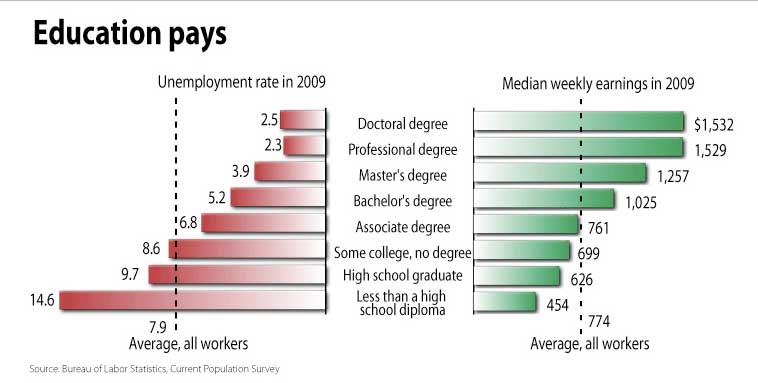
Education Still Pays
Education Still Pays – Source: TheAtlantic.com
It just makes sense. The more education you have, the more you are likely to earn over your lifetime. Even in a tough job market and burdened with student loans, the college graduate will have the advantage over those who don’t advance beyond high school.

$1.2 Million More

The Federal Bank of New York recently released a report confirming the value of higher education. Those who earn a bachelor’s degree can expect to earn about $1.2 million more during the usual work years — ages 22 to 64 — than their peers who stop short of that educational milestone.

Even those with an associate’s degree are expected to outstrip their non-degreed friends by some $325,000 over their work lives, reported the study, which was based on U.S. Census Bureau and Bureau of Labor data.

The college-educated have lower unemployment rates and are less likely to live in poverty, the statistics showed.

Between 1970 and 2013, those with a bachelor’s degree earned on average about $64,500 per year; those with an associate’s degree about $50,000; and those with a high school diploma about $41,000 per year.

The higher earnings tend to more than offset the costs of higher education, the report indicated. A bachelor’s degree, after subtracting tax benefits and financial aid awards, cost an average $122,000 in 2013. The cost for an associate’s degree in the same year was $43,700. Most college students also lose the income they could have earned while they are studying.

More Earning Power

Even so, college graduates have more earning power than their less-educated peers, according to data gathered by the Bureau of Labor Statistics and the College Board. Most employers, even if they provide only basic employment, will pay more for workers with any level of post-high school education.

In an Associated Press report on the New York study, the example of recent college graduate Katie-Beth Vornberger, age 24, was cited. She graduated in May from George Mason University, taking away with her some $20,000 in debt. She had worked part-time to help cover her tuition. She was immediately employed by a consulting firm that manages social media accounts at a salary $4 per hour more than she was earning while in school. She hopes for a full-time job with the firm and has expectations that her higher education will soon begin paying off.

Though it has always been clear that there are avenues besides college that lead to valuable job preparation, the statistics continue to affirm that some formal training, including trade schools and on-the-job experience, will lead to more earnings over a lifetime.

Filed Under: Careers

  • « Go to Previous Page
  • Page 1
  • Page 2
  • Page 3
  • Go to Next Page »

Primary Sidebar

Personal Finance Articles

  • Make Saving A Priority
  • Review Your Home-Insurance Risks
  • Lowest Air Fare? Try August 28
  • Hackers Targeting Bitcoins
  • Keep Your Emergency Fund Intact

Save At Walmart

Search

Personal Finance Education

Investing Education from Morningstar.

As Seen On Intuit

Intuit.com has ranked Coolchecks.net #4 out of 10 of the best blogs to help you save money. We hope to help you become more aware of your own financial situation and strive to improve it.

Featured On Mint.com – July 2014

Mint Interview

Categories

  • Banking
    • Check Writing
    • Checking Accounts
    • Credit Cards
    • EMV Cards
    • Fees
    • Fraud
    • History
    • Student Loans
  • Best Of The Web
  • Budgets
    • Emergency Fund
    • Grocery Shopping
    • Saving Money
    • Spending Habits
  • Business
    • 3D Printing
    • Bankruptcy
    • Business Advertising
    • Business Development
    • Business Plans
    • Corportate Lessons
    • Data Mining
    • Legal Issues
    • Merchants
    • SEC
    • Security
    • Small Business Startups
  • Consumer Alerts
  • Cryptocurrency
  • Cutting Costs
  • Employment
    • best places to work
    • Careers
    • Interviews
    • Job Search
    • Top CEOs
    • Wages
  • Entrepreneurs
    • Attitudes
    • Entrepreneur Interviews
  • Featured
  • Finance
    • Automobiles
    • Credit Ratings
    • Education
    • Financial Planners
    • Foreclosures
    • Homes
    • Insurance
    • Investing
    • Mortgages
    • Personal Finance
    • Renting
    • Term Deposits
    • Travel
    • Work
  • Fraud
  • Government
  • Holidays
    • Christmas
    • Halloween
  • Internet
    • Bitcoin
    • Blogging Tips
    • Blogs, RSS and Podcasting
    • Databases
    • Facebook
    • Influence
    • marketing
    • Twitter
    • Website Reviews
    • WordPress
      • Key Words
  • Investing Basics
    • Hedge Funds
    • Investing
    • Mutual Funds
  • Life
    • Aging
    • Just For Fun
      • Punahou Alumni Corner
    • Millennials
    • Personal Health
  • Money Making Ideas
    • Affiliate Programs
    • Craigslist
    • Ebay
  • Money Management
    • Bankruptcies
    • Building Wealth
    • Child Care Costs
    • Christmas Shopping
    • Credit
      • Free Credit Report
    • Debit Cards
    • Debt
    • Debt Reduction
    • Health Insurance
    • Income
    • Inheritance
    • Interest Rates
    • Loans
    • Mortgages
    • New Years Resolutions
    • Retirement
    • Shopping Tips
    • Tax Strategies
    • Your Stories
  • Retirement
  • Self Improvement
    • Time Management
    • Work Habits
  • Shopping
    • Coupons
    • Online Shopping
  • Social Security
  • Tax Tips
  • Taxes
  • Technology
  • Trade
  • Uncategorized
  • Wealth

Best of Personal Finance Blogs

Best of BuyerZone Business Finance Blog Recipient

Personal Finance Sites We Recommend

Get personal finance advice from the people behind the top money blogs, including Wise Bread, The Simple Dollar, Mint and Nerd Wallet.

Copyright © 2026 ·Metro Pro · Genesis Framework by StudioPress · WordPress · Log in