
• Skip to primary navigation
  • Skip to main content
  • Skip to primary sidebar
  • Money Management
    • Debt Reduction
    • Credit
    • Mortgages
    • Mutual Funds
    • Tax Strategies
    • Loans
  • Budgets
    • Saving Money
    • Income
  • Banking
    • Checking Accounts
    • Check Writing
    • Fraud
    • History
  • Entrepreneurs
    • Entrepreneur Interviews
    • Money Making Ideas
    • 3D Printing
  • Resources
  • Retirement
  • About
    • Privacy Policy

Personal Finance Blog

Tips And Stories To Help You With Managing Money

  • Privacy Policy
  • Saving Money In 2018
You are here: Home / Archives for Money Management

Money Management

Retirement Plans Are Not Always Available

June 22, 2016 By Twila Van Leer

Many employees don't have access to a company retirement plan.
Many employees don’t have access to a company retirement plan.

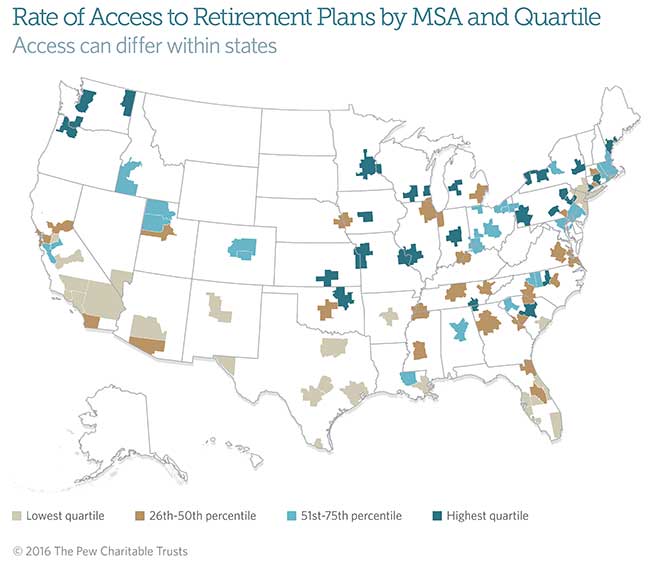
Retirement systems in America are not always available to people. The The Pew Charitable Trusts is an organization that helps states and cities to design
retirement systems that are affordable. They have conducted a study that identified areas of the country that have the most access to retirement plans. The results revealed that access varies more among the nation’s metropolitan areas than across states as a whole.

For instance, workers in Grand Rapids, Mich. had the greatest rates of access, at 71 percent and those in McAllen, Tex., the lowest at 23 percent, the Pew study showed in a comparison of 104 metropolitan areas. Overall, the nationwide percentage of workers who had access to a plan was 58.

Fewer Employers Offer Retirement Pensions

With fewer companies offering standard retirement pensions, the importance of a workplace retirement plan is increasingly important to those looking at retirement. Workers are looking more to a 401(k) or other option to help them supplement their anticipated Social Security.
Retirement savings plans offered by employees give people the ability to save  for retirement.
Retirement savings plans offered by employees give people the ability to save for retirement.

Even so, 40 percent of full-time private sector employees say they don’t have access to an employer-supported plan. Local governments look at the reality and are concerned that helping retirees to survive financially may come home to roost with them. Policy questions are on local agendas and state agendas as officials look at the possibility of stresses on such programs as Medicaid, food assistance and other support systems.

State-run Savings Plan

Illinois has enacted a state-run retirement savings plan for some workers who have no workplace access. The plan will go into operation in 2017.

Federal Government Concerns

The federal government has concerns as well, particularly as the long-range health of Social Security is in question. Several policies to encourage savings have been instituted, including the Pension Protection Act of 2006, which enabled prospective retirees to make automatic contributions to a 401(k) plan.

myRA

President Obama created myRA, to assist people who don’t have access to a company retirement plan so they can save individually. myRAs will be invested solely in government bonds and will be backed by the U.S. government.

Pew found that the Northeast, Upper Midwest and Pacific Northwest regions of the country have the highest rates of worker access to retirement savings plans, while the areas with the lowest rates are in the South and parts of the West.


Filed Under: Retirement, Social Security Tagged With: Retirement, social security

Finances Change With Divorce

June 17, 2016 By Twila Van Leer

Knowing how to manage money after divorce is essential.
Unfortunately, in a society where divorce is common, no one expects women to be expert in personal finances. They tend to know more about weight loss, cooking and other traditionally feminine matters.

But, according to DivorcedMoms.com, knowing about money and how to manage it (especially when a divorce may have drastically cut your resources) can become absolutely essentially in your new reality. Here are some tips to help in the process.

Hope For The Best, But Be Prepared For The Worst

Though your ex may be as generous as he promised he would be, it often happens that support money begins to lag. Insist on discussing money issues as the split occurs. You’re better off, if possible, to plan on taking care of yourself financially. If you get all the help you are promised, you’ll be pleasantly surprised, and if not, you won’t be devastated.

Educate Yourself

Financial training for women should begin in high school, but it seldom does. If possible, plan to do your own taxes and hone your budgeting and investing skills. Find a consultant, research online or get advice from someone you trust.

Regular Savings Plan

If work is part of the equation for you, be certain that some set percentage of your income goes into savings. Take advantage of employer participation in a retirement savings, if that is feasible. If you still have dependent children, buying a home may be very desirable. But be sure that it’s affordable and leaves you enough for other necessities, including education for the kids. If you need to upgrade employment skills, there are agencies that offer free services or can steer you to affordable options. Don’t be reluctant to explore any options, including government support, if it is necessary to provide for your family.

Have A Strategy

Create long-term goals, including concrete plans on how you are going to achieve them. Get rid of what you don’t need in favor of the things that will help you reach your goals. Be sure your goals are realistic, seeking counseling if necessary to stay within reason. Most women have some assets, such as jewelry or over-expensive cars, that they can convert to cash if necessary. Incurring more debt trying to become financially self-reliant is not a wise way to go.

Live Within Your Budget

It may even do your children good to be forced to expect less. Teach them to live realistically within the new budget now in place. They could thank you for it later. Keep in mind that the old saying is true: You can’t buy happiness. Look for free entertainment, such as board games at the kitchen table, home movie nights, visits to the library, nature walks, local parks, etc.
Love and attention don’t cost anything and they’re the greatest gifts you can give your child. Don’t let your emotional fallout become their problem.

Seek Mediation If Necessary

Resist going to court with your ex-spouse for every dissatisfaction. Lawyers are expensive and courts not cheap. . With divorce child support orders can be changed if your circumstances change, but don’t make money a constantly divisive issue that too often puts children in the middle.

Look around you at all the women who have divorced and succeeded. One needn’t automatically exclude the other. Divorce creates challenges, but it isn’t the end. Learn from it, plan for success and stick with the plan.

Filed Under: Money Management, Personal Finance, Saving Money Tagged With: Budgeting, money management, Personal Finance, Saving Money

When To Begin Social Security

June 9, 2016 By Twila Van Leer

Social security main source of income for retirees.
A growing number of Americans are starting to withdraw Social Security benefits before reaching full retirement age, according to a research poll conducted by Associated Press and the NORC Center for Public Affairs and reported by the AP.

Forty-four percent of those polled said they will look to Social Security for their main means of financial support after retirement and they will start collecting before they reach 65 or 66, the benchmark for receiving full benefits.

Benefits Reduced If Collect Early

Social Security regulations allow retirees who were born in the period from 1943 and 1954 to begin collecting as early as 62 years of age, but the benefit is reduced by up to 30 percent. That can have a significant effect on the long-term benefit.

Retirees who wait until they over 66 years of age see considerable increases in their monthly benefit, according to experts at the AARP Public Policy Institute. For each additional year past 66, the amount of retirement pay rises by 8 percent. The benefits top out at age 70, at which time the retiree is receiving the maximum amount.

Individual Circumstances Affect Retirement Decisions

But many Americans can’t or don’t want to wait that long to begin collecting, depending on their individual circumstances. Health and other considerations may weigh heavily in decisions to retire. Some people who lose their employment while approaching retirement are not able to get another job and early withdrawal of Social Security funds is a necessary option.

Social Security Main Source Of Income

Social Security is becoming more and more the main source of anticipated income for the retirement crowd. Fewer companies are offering standard retirement plans, opting to offer employees 401(k) and other plans to provide for their old age years. Only 43 percent of those polled said they are expecting a traditional pension.

Supplementing Social Security

Some workers, about 50 percent, reported that they also have other padding, such as a regular savings or IRA account, but some Social Security is by far the most commonly anticipated source, the survey found. Some 86 percent of those polled said they expect Social Security to contribute to their retirement income.

Retirement Age Rising

The average retirement age has been rising, as more Americans, particularly women, see the necessity for working longer to make retirement affordable. The average age for males is 64, and 62 for females. Compared with other countries, the American retirement ages still are relatively young.

Many factors enter into the retirement decision, including life expectancy data that show there are differences between rich and poor and among ethnic groups.

Questions about the solvency of the country’s most–drawn on retirement finance source have been a troubling aspect of the issue for some time. Since 1984, the program’s trust fund has run a surplus, but that is expected to end by around 2020 when the Baby Boomer generation hits the retirement ranks. The Social Security Administration believes interest income from the fund should be able to handle the increase until 2034, but at that point, the possibility of shrinkage in benefits could become a reality unless the issues are addressed. The matter is part of the current presidential debates taking place before the November elections. Democratic front-runner Hillary Clinton sees a need for expansion of the program, while likely Republican candidate Donald Trump has declared it should not be changed.

Filed Under: Retirement, Saving Money, Social Security Tagged With: Retirement, Saving Money, social security

Living Wage Laws Difficult To Enforce

May 28, 2016 By Twila Van Leer

For the cities that endorse the Living Wage Law, ensuring compliance is difficult.

A number of cities have bowed to pressure from labor advocates and enacted “living wage” laws, some of them phasing in plans that will top out at $15 per hour.

A living wage is the minimum income necessary for a worker to meet their basic needs. It was designed to fight poverty, but the ripple effects that come after cities actually adopt the Living Wage Laws are numerous.

Ensuring that employers actually follow the new guidelines is difficult. State and federal laws don’t require employers to provide data proving that they are in compliance, oversight agencies say. The data is most often contained in payment check stubs, but employers are not required to share the information.

Cities That Use Living Wage Laws

Among cities that have adopted the wage increases are Santa Fe and Albuquerque, New Mexico, San Francisco, California, and Washington D.C. The issue is on the agendas of many state legislatures and city governments as the press for better wages heats up.

Complaints

Enforcers generally rely on worker complaints to initiate actions against employers who do not conform, but the employees are reluctant to complain for fear of reprisals, so many instances of non-compliance go unnoticed. Labor groups estimate that a quarter of the country’s workers who fall under the guidelines are not receiving the legislated wages. But if one employee complains, enforcers use it as leverage to investigate pay records for all of the business’ employees on the supposition that the problem affects more than the single complainant.

Recommendations For Enforcement

Haeyoung Yoon of the National Employment Law Project calls the problem “pervasive and rampant” in an Associated Press news article. The project recommends higher fines against non-compliant employers and more stringent enforcement. The costs of enforcement are high, but could be recouped through fines, she said.

Some employers don’t understand the new laws, but others sidestep the provisions by requiring workers to work unpaid or off the clock to make up the difference. Others raise the wage, but cut the benefits.

Law Suits

Hospitality and transportation workers serving in SeaTac, Washington are granted the Living Wage Law. This community however needed courts to enforce compliance and have filed more than a dozen class-action suits this year in behalf of workers. The total amount of contested wages, related benefits and possible penalties could add up to $62.5 million.

Filed Under: Employment, Income, Legal Issues Tagged With: Employment, making money, Minimum Wage

Compulsive Shopping May Be Sign Of Trouble

May 23, 2016 By Twila Van Leer

How do you know if you have a problem with compulsive shopping?
If you start shopping and can’t quit, there could be serious complications ahead. Losing control of shopping habits indicates an impulse control disorder that is similar to addictive disorders, but without the drugs.

Factors That May Increase Behavior

A multiplicity of social and cultural factors may enter the picture by increasing the addictive behavior. One is today’s easy access to credit and society’s general focus on material things. People are encouraged to accumulate possessions now and pay later. Online shopping and television stations that focus on sales day and night add to the possibility.

What Are The Signs That Your Shopping Is Out Of Control?

Spending and shopping to offset disappointment, anger, discomfort or fear tops the list. If you are stressed by your own habits to the point of emotional distress, be concerned. Arguing with a spouse or other significant person over spending is a clue. Also on the list are feeling lost without credit cards, buying items on credit that you wouldn’t buy if you were paying cash, getting a “rush” from spending, experiencing guilt, shame or embarrassment after a spree, lying about how much you spend, thinking excessively about money or spending time trying to reconcile your accounts and bills.

How Do You Know If You Have A Problem?

Four or more of the above indicate a problem. You might get a feeling or happiness and power while spending, but you have to keep shopping to maintain that feeling. The brief but intense emotional high doesn’t last long.

Consequences Of Addiction

Researchers have related compulsive spending with interpersonal difficulties, occupational consequences, and family/financial problems. Anxiety and depression may be more troublesome as spending gets out of hand. Borrowing money to cover credit buying exacerbates the problem. Too often, the extent of an addict’s spending doesn’t become apparent until the debt becomes overwhelming. Then a drastic change in lifestyle becomes an absolute necessity, and the emotional effects come home to roost.

How To Get Help

If you suspect you may have gone too far in your spending, contact a certified addictions counselor. Your regular physician may be able to help in locating one. Check your state health agency or a local hospital to see if they can direct you to the help you need. The American Psychiatric Association also has resources that are useful.

Better at this stage of things to spend a little time rather than any more money.

Filed Under: Debt, Self Improvement, Spending Habits Tagged With: Debt, money management, Personal Finance

  • « Go to Previous Page
  • Page 1
  • Interim pages omitted …
  • Page 12
  • Page 13
  • Page 14
  • Page 15
  • Page 16
  • Interim pages omitted …
  • Page 43
  • Go to Next Page »

Primary Sidebar

Personal Finance Articles

  • Make Saving A Priority
  • Review Your Home-Insurance Risks
  • Lowest Air Fare? Try August 28
  • Hackers Targeting Bitcoins
  • Keep Your Emergency Fund Intact

Save At Walmart

Search

Personal Finance Education

Investing Education from Morningstar.

As Seen On Intuit

Intuit.com has ranked Coolchecks.net #4 out of 10 of the best blogs to help you save money. We hope to help you become more aware of your own financial situation and strive to improve it.

Featured On Mint.com – July 2014

Mint Interview

Categories

  • Banking
    • Check Writing
    • Checking Accounts
    • Credit Cards
    • EMV Cards
    • Fees
    • Fraud
    • History
    • Student Loans
  • Best Of The Web
  • Budgets
    • Emergency Fund
    • Grocery Shopping
    • Saving Money
    • Spending Habits
  • Business
    • 3D Printing
    • Bankruptcy
    • Business Advertising
    • Business Development
    • Business Plans
    • Corportate Lessons
    • Data Mining
    • Legal Issues
    • Merchants
    • SEC
    • Security
    • Small Business Startups
  • Consumer Alerts
  • Cryptocurrency
  • Cutting Costs
  • Employment
    • best places to work
    • Careers
    • Interviews
    • Job Search
    • Top CEOs
    • Wages
  • Entrepreneurs
    • Attitudes
    • Entrepreneur Interviews
  • Featured
  • Finance
    • Automobiles
    • Credit Ratings
    • Education
    • Financial Planners
    • Foreclosures
    • Homes
    • Insurance
    • Investing
    • Mortgages
    • Personal Finance
    • Renting
    • Term Deposits
    • Travel
    • Work
  • Fraud
  • Government
  • Holidays
    • Christmas
    • Halloween
  • Internet
    • Bitcoin
    • Blogging Tips
    • Blogs, RSS and Podcasting
    • Databases
    • Facebook
    • Influence
    • marketing
    • Twitter
    • Website Reviews
    • WordPress
      • Key Words
  • Investing Basics
    • Hedge Funds
    • Investing
    • Mutual Funds
  • Life
    • Aging
    • Just For Fun
      • Punahou Alumni Corner
    • Millennials
    • Personal Health
  • Money Making Ideas
    • Affiliate Programs
    • Craigslist
    • Ebay
  • Money Management
    • Bankruptcies
    • Building Wealth
    • Child Care Costs
    • Christmas Shopping
    • Credit
      • Free Credit Report
    • Debit Cards
    • Debt
    • Debt Reduction
    • Health Insurance
    • Income
    • Inheritance
    • Interest Rates
    • Loans
    • Mortgages
    • New Years Resolutions
    • Retirement
    • Shopping Tips
    • Tax Strategies
    • Your Stories
  • Retirement
  • Self Improvement
    • Time Management
    • Work Habits
  • Shopping
    • Coupons
    • Online Shopping
  • Social Security
  • Tax Tips
  • Taxes
  • Technology
  • Trade
  • Uncategorized
  • Wealth

Best of Personal Finance Blogs

Best of BuyerZone Business Finance Blog Recipient

Personal Finance Sites We Recommend

Get personal finance advice from the people behind the top money blogs, including Wise Bread, The Simple Dollar, Mint and Nerd Wallet.

Copyright © 2026 ·Metro Pro · Genesis Framework by StudioPress · WordPress · Log in