• Skip to primary navigation
  • Skip to main content
  • Skip to primary sidebar
  • Money Management
    • Debt Reduction
    • Credit
    • Mortgages
    • Mutual Funds
    • Tax Strategies
    • Loans
  • Budgets
    • Saving Money
    • Income
  • Banking
    • Checking Accounts
    • Check Writing
    • Fraud
    • History
  • Entrepreneurs
    • Entrepreneur Interviews
    • Money Making Ideas
    • 3D Printing
  • Resources
  • Retirement
  • About
    • Privacy Policy

Personal Finance Blog

Tips And Stories To Help You With Managing Money

  • Privacy Policy
  • Saving Money In 2018
You are here: Home / Archives for Investing Basics

Investing Basics

Mutual Funds For Dummies

March 19, 2012 By Sherry Tingley

Mutual funds are an investment vehicle that is made up of a pool of funds.  The funds are then invested by professional manager(s) in a variety of companies. The funds can include securities, stocks, bonds, equities and other investments. The benefits of mutual funds for the small investor is a diversified portfolio which would be hard (if not impossible) to create with a small amount of capital. The investor’s money is invested in many different companies which can mitigate  investment risks. This allows individuals to avoid putting all of their “eggs in one basket.” Usually people don’t have large sums of money to invest so by pooling money and investing as a team, their buying power is greater than if they invested by themselves.

Each mutual fund has professional managers that manage the pool of the funds. When researching which mutual funds to invest in, it is wise to look at the length of time the managers have been managing the fund. Those that have been doing it for many years, obviously have more experience that is measured by the various performance related graphs.

Asset Allocation

The new investor will have difficulty deciding what funds to invest in unless they have some guidance and understand how to interpret the data provided to them. Everyone has a different goal in mind when investing. Some general guidelines are to make equal investments in each type of funds. There are four types of mutual funds: Large Cap Funds, Mid Cap Funds, Small Cap Funds and International Funds. Equally investing in each type of fund can help to reduce the volatility of the markets.

Researching Mutual Funds
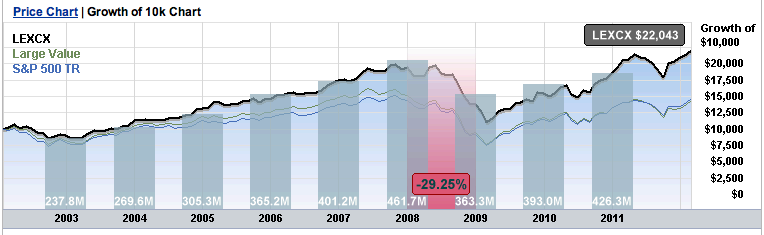
Mutual Fund Growth Chart
ING Funds Performance - Click For Larger View

Technology has made finding good funds to invest in much simpler than you might think. All of the fund performance data is collected and shown in a variety of ways.

The performance of the fund over time can be compared with the S&P 500 index. This index began in 1957. The S&P 500 index shows the top 500 large cap stocks. These companies have growth stocks and value stocks. The index is considered a “bellweather” of the United States economy.

The companies in the S&P 500 index are chosen by a committee to represent the industries in the U.S. economy. It has a wide variety of industry sectors included in it. The consumer discretionary sector includes companies like Home Depot, Lowe’s, Best Buy, Macy’s, Kohls, MacDonalds and Starbucks. Consumer Staples include Clorox, Walmart, Coca Cola and Walgreens. The energy sector includes companies like Exxon, Chevron, Hess Corporation and Haliburton Co. The financial sector includes companies like Citi Group, Etrade, Wells Fargo, Morgan Stanley and American Express. Health care, industrials, information technology, materials, telecommunications and utilities are the remaining sectors of companies listed in the S&P 500.

You can see the performance of every mutual fund compared to the performance of the S&P 500. You can also see the growth of a $10,000 investment over a 10 year period of time. This data can help you make guided choices and increase your chances of financial growth.

This information is meant to help you improve your knowledge about investing in mutual funds. There is no guarantee of your success in investing. You need to make sure you research the funds you want to invest in and see if they match your investing strategies and your tolerance of risk.

Purchasing mutual funds can be done online and doesn’t require you writing out checks.
Sherry Tingley

Filed Under: Investing Basics, Mutual Funds Tagged With: Investing, mutual funds, Saving Money

The Future Of Apple Without Steve Jobs

October 31, 2011 By Sherry Tingley

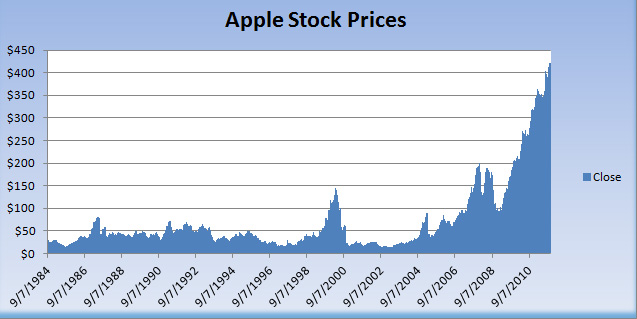
Apple Stock Prices from 1984 - 2011
The Rise Of Apple Stock Prices

What does the future of Apple look like without Steve Jobs? Analysts are predicting a very bright future.

Today, Apple is worth $377.83 billion dollars. Share prices are fluctuating between $401 – $409.  It is the largest company in the world and new products are in development.  The iTV, which is currently in the prototype stage, could revolutionize the television industry and it could add billions of dollars to the worth of Apple.

Gene Munster, analyst for Piper Jaffray, a $400 million dollar investment company, says “We believe that of the estimated 220 million flat panel TVs sold in 2012, 48% or 106 million units will be internet-connected, of which Apple could sell 1.4 million units,” Munster wrote. “We believe an Apple Television could add $2.5 billion or 2% to revenue in 2012, $4.0 billion or 3% in 2013 and $6.0 billion in 2014.”

Will that make investing in Apple now a good investment? David Zeiler writes an interesting article: Why Apple Stock Is Headed for $500 – And Beyond. The momentum behind Apple seems to be growing past the loss of it’s founder, Steve Jobs.

A recent book called “Steve Jobs,” by Walter Isaacson, clearly reveals the thinking that has been driving the success of the company for years. Steve’s out of the box, creative thinking has gotten the masses to use computers in a new way. From the launch of the MacIntosh in 1984, to the recent launch of the Ipad2, his products provided us with the next generation of technology.

Designing products with ease of use has been Steve Job’s philosophy. Thank goodness, because the masses are not tech geeks. His artistic sense of design, minimalistic lifestyle and obsessive attention to detail are the fuel behind the products we have come to love and use daily.

From his high school part-time job working at Hewlett-Packard, Steve Jobs found one mentor after the next to teach him about technology, product creating, business structure and relationships. Although not always the best at relationships, his demand for perfection and his drive for great product creation triumphed.

There is a future for Apple because of Steve Jobs. His vision and creative thinking will truly be missed, but his contributions to the world will benefit generation after generation.


Related Company Valuations – October 31, 2011


Apple Inc. 377.68B
Microsoft Corporation 225.50B
IBM 218.78B
Google Inc. 193.01B
Oracle Corporation 166.52B
Intel Corporation 129.99B
Verizon Communications… 105.09B
Amazon.com, Inc. 97.32B
Hewlett-Packard Company 53.35B
Dell Inc. 29.15B


1984 Launch of the Macintosh

 
Coolchecks.net, the best place to order checks.

Filed Under: Business Development, Investing Tagged With: Money Making Ideas, Steve Jobs

Learning Personal Finance With Investment Clubs

September 19, 2009 By Sherry Tingley

If you are someone who would like to know more about investing, joining or starting an investment club can be a rewarding and educational experience. Many people feel more comfortable about learning about investing with other average folks when compared with talking to an expert.

Is it a good fit for you?

If you have been putting off learning about investing and setting any money aside, the discipline of a club could be ideal. Many people join a club to have a group that they can talk to about investing and apply what they learn to their own portfolios. If you have $20-$50 a month to set aside and invest through a club, you might find membership is for you.

Even experienced investors use a club to gain information about stocks that they do not have the time to research. Many hands make light work. All members benefit from the work of other members. Work? Yes you need to contribute more that cash. Don’t think that you can take a free ride. The pooled account may not be significant when compared to your 401(k) but everyone has a stake and needs to commit.

How Do These Things Start?

Groups of friends, neighbors or co-workers start talking about investing and find that a starting an investment club is the next step. Setting up a club takes some work but the National Association of Investors Corporation (NAIC) has all the information you need to get started.

How Do They Work

Successful investment clubs focus on learning as well as investing. Guest speakers, like a local broker or investment analyst, may be invited from time to time. Most people join a club to explore new ideas and discuss investing issues. In the early sessions of a club’s life, education might be very introductory, covering how to read a balance sheet, an earnings report and the club’s financials. Soon the club might be learning new ways to value stocks or discussing a book about Warren Buffett.

Clubs Are Work: Why Not Try a Money-Free Club?

Many clubs have fallen by the wayside when members realize that the time involved is significant. Often the treasurer feels this first. Because of this, groups that want to get started but are a bit intimidated at the paperwork, try a money-free club.

Some money-free clubs will focus on education only. Others will set up fantasy portfolios on a web site and buy and sell and do all the work, but with no real money in.

Advantages

No monthly contributions.? No need for a treasurer.? No accounts to keep and taxes to pay.? Great for people who are hesitant to commit to a regular club.

Disadvantages

People often lose their discipline if they’re not bound together by pooled money.? Often people take a money-free club less seriously. ? It’s less fun and exciting for some people, if there’s no real money involved.

Article Source: http://EzineArticles.com/?expert=Russell_Seed

Filed Under: Investing Tagged With: Investing, investment clubs, Personal Finance

  • « Go to Previous Page
  • Page 1
  • Interim pages omitted …
  • Page 3
  • Page 4
  • Page 5

Primary Sidebar

Personal Finance Articles

  • Make Saving A Priority
  • Review Your Home-Insurance Risks
  • Lowest Air Fare? Try August 28
  • Hackers Targeting Bitcoins
  • Keep Your Emergency Fund Intact

Save At Walmart

Search

Personal Finance Education

Investing Education from Morningstar.

As Seen On Intuit

Intuit.com has ranked Coolchecks.net #4 out of 10 of the best blogs to help you save money. We hope to help you become more aware of your own financial situation and strive to improve it.

Featured On Mint.com – July 2014

Mint Interview

Categories

  • Banking
    • Check Writing
    • Checking Accounts
    • Credit Cards
    • EMV Cards
    • Fees
    • Fraud
    • History
    • Student Loans
  • Best Of The Web
  • Budgets
    • Emergency Fund
    • Grocery Shopping
    • Saving Money
    • Spending Habits
  • Business
    • 3D Printing
    • Bankruptcy
    • Business Advertising
    • Business Development
    • Business Plans
    • Corportate Lessons
    • Data Mining
    • Legal Issues
    • Merchants
    • SEC
    • Security
    • Small Business Startups
  • Consumer Alerts
  • Cryptocurrency
  • Cutting Costs
  • Employment
    • best places to work
    • Careers
    • Interviews
    • Job Search
    • Top CEOs
    • Wages
  • Entrepreneurs
    • Attitudes
    • Entrepreneur Interviews
  • Featured
  • Finance
    • Automobiles
    • Credit Ratings
    • Education
    • Financial Planners
    • Foreclosures
    • Homes
    • Insurance
    • Investing
    • Mortgages
    • Personal Finance
    • Renting
    • Term Deposits
    • Travel
    • Work
  • Fraud
  • Government
  • Holidays
    • Christmas
    • Halloween
  • Internet
    • Bitcoin
    • Blogging Tips
    • Blogs, RSS and Podcasting
    • Databases
    • Facebook
    • Influence
    • marketing
    • Twitter
    • Website Reviews
    • WordPress
      • Key Words
  • Investing Basics
    • Hedge Funds
    • Investing
    • Mutual Funds
  • Life
    • Aging
    • Just For Fun
      • Punahou Alumni Corner
    • Millennials
    • Personal Health
  • Money Making Ideas
    • Affiliate Programs
    • Craigslist
    • Ebay
  • Money Management
    • Bankruptcies
    • Building Wealth
    • Child Care Costs
    • Christmas Shopping
    • Credit
      • Free Credit Report
    • Debit Cards
    • Debt
    • Debt Reduction
    • Health Insurance
    • Income
    • Inheritance
    • Interest Rates
    • Loans
    • Mortgages
    • New Years Resolutions
    • Retirement
    • Shopping Tips
    • Tax Strategies
    • Your Stories
  • Retirement
  • Self Improvement
    • Time Management
    • Work Habits
  • Shopping
    • Coupons
    • Online Shopping
  • Social Security
  • Tax Tips
  • Taxes
  • Technology
  • Trade
  • Uncategorized
  • Wealth

Best of Personal Finance Blogs

Best of BuyerZone Business Finance Blog Recipient

Personal Finance Sites We Recommend

Get personal finance advice from the people behind the top money blogs, including Wise Bread, The Simple Dollar, Mint and Nerd Wallet.

Copyright © 2026 ·Metro Pro · Genesis Framework by StudioPress · WordPress · Log in