• Skip to primary navigation
  • Skip to main content
  • Skip to primary sidebar
  • Money Management
    • Debt Reduction
    • Credit
    • Mortgages
    • Mutual Funds
    • Tax Strategies
    • Loans
  • Budgets
    • Saving Money
    • Income
  • Banking
    • Checking Accounts
    • Check Writing
    • Fraud
    • History
  • Entrepreneurs
    • Entrepreneur Interviews
    • Money Making Ideas
    • 3D Printing
  • Resources
  • Retirement
  • About
    • Privacy Policy

Personal Finance Blog

Tips And Stories To Help You With Managing Money

  • Privacy Policy
  • Saving Money In 2018
You are here: Home / Archives for Investing Basics / Mutual Funds

Mutual Funds

Reducing Fees in Mutual Fund Investments

December 15, 2012 By Richard Cox

Investing money is one way that Coolchecks.net recommends you use to enhance your personal finance strategies. Here is a short guide to mutual funds.

Mutual Fund Investment Guide

Selecting a winning mutual fund can seem like a daunting task, so whether you are looking to invest in a managed fund based on your own interest or if you are forced to do this because index funds are not provided by your 401(k), it pays to have an understanding of the basic workings of these instruments and the ways mutual funds tend to behave in relation to the broader market. First, it is important to understand that many mutual funds underperform the many benchmark stock indices because of the fees that are associated with these investments.

As client investors, our primary task is to ensure that these fee charges are low, as this gives us a better chance to achieve returns that beat the rest of the market. To do this, we will summarize the major terms that you will inevitably encounter when buying into a mutual fund and then give a short checklist that should be followed before any real investments are made.

Expense Ratios

Expense ratios are created by the annual fees that are charged by all mutual funds. These fees combine administrative costs, distribution fees, management fees, and operating costs. These costs are combined and calculated as a percentage to total assets. Actively managed mutual funds usually have expense ratios in the neighborhood of 1.5% per year. Ideally, look for expense ratios of 1% or less, but this might take some work since average fees have been rising in recent years.

Understanding Turnover

The next essential element to understand is “turnover,” which measures the length of time a mutual hold will hold a stock. Funds incur expenses whenever a fund is bought or sold, so if a fund holds onto a stock for a longer period of time, there will be fewer trading expenses. Additionally, capital gains taxes will also be lower when turnover rates are correctly managed.

If, for example, a fund has a turnover rate of 100%, that fund will buy an entirely new collection of stocks each year. Mutual funds average turnover rates of 80% but it is possible to find funds with substantially lower rates (sometimes even as low as 5%). The lower the rate, the lower the charges that will be later transferred to the investor.

A Checklist for Mutual Fund Investors

A summary checklist to use when looking for winning mutual funds should look like this:

1.  No sales charges for clients (this includes level loads, front loads, and sales loads that are contingent deferred)
2.  An expense ratio that is lower than its peers (usually below 1%)
3.  Low turnover relative to the competition, (generally lower than 50% a year, a number closer to 20% is preferred).
4.  Fund policy that remains fully invested. (Cash reserves of something close to 0%.)

Understanding these aspects of mutual fund investing can be important in ensuring we achieve returns that beat the wider market. In short, we are looking to keep our fees low and to choose low turnover funds, as these tend to give us the best chance enhancing returns.
Filed Under: Mutual Funds Tagged With: Investing, mutual funds

Mutual Funds For Dummies

March 19, 2012 By Sherry Tingley

Mutual funds are an investment vehicle that is made up of a pool of funds.  The funds are then invested by professional manager(s) in a variety of companies. The funds can include securities, stocks, bonds, equities and other investments. The benefits of mutual funds for the small investor is a diversified portfolio which would be hard (if not impossible) to create with a small amount of capital. The investor’s money is invested in many different companies which can mitigate  investment risks. This allows individuals to avoid putting all of their “eggs in one basket.” Usually people don’t have large sums of money to invest so by pooling money and investing as a team, their buying power is greater than if they invested by themselves.

Each mutual fund has professional managers that manage the pool of the funds. When researching which mutual funds to invest in, it is wise to look at the length of time the managers have been managing the fund. Those that have been doing it for many years, obviously have more experience that is measured by the various performance related graphs.

Asset Allocation

The new investor will have difficulty deciding what funds to invest in unless they have some guidance and understand how to interpret the data provided to them. Everyone has a different goal in mind when investing. Some general guidelines are to make equal investments in each type of funds. There are four types of mutual funds: Large Cap Funds, Mid Cap Funds, Small Cap Funds and International Funds. Equally investing in each type of fund can help to reduce the volatility of the markets.

Researching Mutual Funds

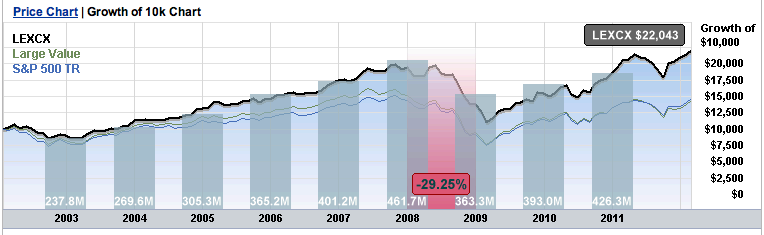
Mutual Fund Growth Chart
ING Funds Performance - Click For Larger View

Technology has made finding good funds to invest in much simpler than you might think. All of the fund performance data is collected and shown in a variety of ways.

The performance of the fund over time can be compared with the S&P 500 index. This index began in 1957. The S&P 500 index shows the top 500 large cap stocks. These companies have growth stocks and value stocks. The index is considered a “bellweather” of the United States economy.

The companies in the S&P 500 index are chosen by a committee to represent the industries in the U.S. economy. It has a wide variety of industry sectors included in it. The consumer discretionary sector includes companies like Home Depot, Lowe’s, Best Buy, Macy’s, Kohls, MacDonalds and Starbucks. Consumer Staples include Clorox, Walmart, Coca Cola and Walgreens. The energy sector includes companies like Exxon, Chevron, Hess Corporation and Haliburton Co. The financial sector includes companies like Citi Group, Etrade, Wells Fargo, Morgan Stanley and American Express. Health care, industrials, information technology, materials, telecommunications and utilities are the remaining sectors of companies listed in the S&P 500.

You can see the performance of every mutual fund compared to the performance of the S&P 500. You can also see the growth of a $10,000 investment over a 10 year period of time. This data can help you make guided choices and increase your chances of financial growth.

This information is meant to help you improve your knowledge about investing in mutual funds. There is no guarantee of your success in investing. You need to make sure you research the funds you want to invest in and see if they match your investing strategies and your tolerance of risk.

Purchasing mutual funds can be done online and doesn’t require you writing out checks.

Sherry Tingley

Filed Under: Investing Basics, Mutual Funds Tagged With: Investing, mutual funds, Saving Money

  • « Go to Previous Page
  • Page 1
  • Page 2

Primary Sidebar

Personal Finance Articles

  • Make Saving A Priority
  • Review Your Home-Insurance Risks
  • Lowest Air Fare? Try August 28
  • Hackers Targeting Bitcoins
  • Keep Your Emergency Fund Intact

Save At Walmart

Search

Personal Finance Education

Investing Education from Morningstar.

As Seen On Intuit

Intuit.com has ranked Coolchecks.net #4 out of 10 of the best blogs to help you save money. We hope to help you become more aware of your own financial situation and strive to improve it.

Featured On Mint.com – July 2014

Mint Interview

Categories

  • Banking
    • Check Writing
    • Checking Accounts
    • Credit Cards
    • EMV Cards
    • Fees
    • Fraud
    • History
    • Student Loans
  • Best Of The Web
  • Budgets
    • Emergency Fund
    • Grocery Shopping
    • Saving Money
    • Spending Habits
  • Business
    • 3D Printing
    • Bankruptcy
    • Business Advertising
    • Business Development
    • Business Plans
    • Corportate Lessons
    • Data Mining
    • Legal Issues
    • Merchants
    • SEC
    • Security
    • Small Business Startups
  • Consumer Alerts
  • Cryptocurrency
  • Cutting Costs
  • Employment
    • best places to work
    • Careers
    • Interviews
    • Job Search
    • Top CEOs
    • Wages
  • Entrepreneurs
    • Attitudes
    • Entrepreneur Interviews
  • Featured
  • Finance
    • Automobiles
    • Credit Ratings
    • Education
    • Financial Planners
    • Foreclosures
    • Homes
    • Insurance
    • Investing
    • Mortgages
    • Personal Finance
    • Renting
    • Term Deposits
    • Travel
    • Work
  • Fraud
  • Government
  • Holidays
    • Christmas
    • Halloween
  • Internet
    • Bitcoin
    • Blogging Tips
    • Blogs, RSS and Podcasting
    • Databases
    • Facebook
    • Influence
    • marketing
    • Twitter
    • Website Reviews
    • WordPress
      • Key Words
  • Investing Basics
    • Hedge Funds
    • Investing
    • Mutual Funds
  • Life
    • Aging
    • Just For Fun
      • Punahou Alumni Corner
    • Millennials
    • Personal Health
  • Money Making Ideas
    • Affiliate Programs
    • Craigslist
    • Ebay
  • Money Management
    • Bankruptcies
    • Building Wealth
    • Child Care Costs
    • Christmas Shopping
    • Credit
      • Free Credit Report
    • Debit Cards
    • Debt
    • Debt Reduction
    • Health Insurance
    • Income
    • Inheritance
    • Interest Rates
    • Loans
    • Mortgages
    • New Years Resolutions
    • Retirement
    • Shopping Tips
    • Tax Strategies
    • Your Stories
  • Retirement
  • Self Improvement
    • Time Management
    • Work Habits
  • Shopping
    • Coupons
    • Online Shopping
  • Social Security
  • Tax Tips
  • Taxes
  • Technology
  • Trade
  • Uncategorized
  • Wealth

Best of Personal Finance Blogs

Best of BuyerZone Business Finance Blog Recipient

Personal Finance Sites We Recommend

Get personal finance advice from the people behind the top money blogs, including Wise Bread, The Simple Dollar, Mint and Nerd Wallet.

Copyright © 2026 ·Metro Pro · Genesis Framework by StudioPress · WordPress · Log in