• Skip to primary navigation
  • Skip to main content
  • Skip to primary sidebar
  • Money Management
    • Debt Reduction
    • Credit
    • Mortgages
    • Mutual Funds
    • Tax Strategies
    • Loans
  • Budgets
    • Saving Money
    • Income
  • Banking
    • Checking Accounts
    • Check Writing
    • Fraud
    • History
  • Entrepreneurs
    • Entrepreneur Interviews
    • Money Making Ideas
    • 3D Printing
  • Resources
  • Retirement
  • About
    • Privacy Policy

Personal Finance Blog

Tips And Stories To Help You With Managing Money

  • Privacy Policy
  • Saving Money In 2018
You are here: Home / Archives for Finance

Finance

5 Lifetime Financial Objectives

April 2, 2013 By Sherry Tingley

Financial success means something different to every person. Some want to have enough money to pay the rent, pay their mortgage and just get by, while others seek to acquire a huge estate. You may want to be a millionaire by age 30, however most people just want to have a comfortable lifestyle. Few people reach financial success without restraining their current spending.

Becoming active in savings for future consumption is a habit everyone needs to get into. According to the book “Personal Finance,” by E. Thomas Garman, from the Virginia Polytechnic Institute and State University, lifetime financial goals generally cover 1.) Maximizing Earnings and Wealth 2.) Practicing Efficient Consumption 3.) Finding Life Satisfaction 4.) Reaching Financial Security 5.) Accumulating Wealth for Retirement and an Estate.

Maximizing Earnings and Wealth

Having an abundance of money and valuable assets requires one fundamental principal: spending less than you earn. Budgeting and planning for this is a top priority. Another goal then needs to be focused on maximizing your earnings. You can accomplish that through employment, entrepreneurship and/or investing. How you do this is entirely up to you and unique to your particular interests and passions.

Practicing Efficient Consumption

We use money either for consuming or saving. Efficient consumption comes from practicing good financial skills, like keeping good financial records, avoiding impulse spending, using credit wisely and keeping living expenses down. Failing to do this is often a result of carelessly spending money on non-essentials and ignoring monthly obligations.

Finding Life Satisfaction

Your satisfaction with life may come from being debt free, owning a home, going on vacations, educating your children, living well in retirement and leaving an inheritance for your children. All of these goals can be achieved through a variety of career paths and every day investment decisions. Financial success offers you a better quality of life whether you want to live well or give your money away.

Reaching Financial Security

Financial security is not about having earned a specific amount of money. It is more in the comfortable feeling you gain when your resources will adequately fill any needs you might have and most of your wants. Free from doubt, anxiety or fear about money is a wonderful place to be. You will need to have a career with potential, an adequate emergency fund, investments an estate plan and a will. Setting short term and long term goals is absolutely essential to achieving financial security.

Accumulating Wealth for Retirement and an Estate

Many financial goals are set to make sure that retirement is a time of life that is comfortable and enjoyable. Seeing this goal as a young adult is really a precious gift. The value of time in savings and investing is really priceless. Anyone who can see that from the start of their careers is on the right course to achieving financial security.
Filed Under: Personal Finance

5 Reasons People Avoid Reading Personal Finance Articles

April 1, 2013 By Sherry Tingley

Personal finance articles are written to help people gain better information about helping themselves improve their financial condition, yet the people who need this information the most often avoid it altogether. Why?

Reason #1 – Lacking Belief

The mindset of a person that is struggling financially is negative. Plain and simply, they do not believe they have the power to change their lives. They then convince themselves that nothing is going to help so why look for help.

Reason #2 – Firm Belief They Are Doing Everything Right

Along with lacking belief, people think that there is nothing more they could possible do. To avoid feeling even worse about themselves, they then avoid learning more.

Reason #3 – They See No Reward In Learning New Strategies

People respond well when given rewards. If they feel they are failing already, then reading more makes them feel worse. There is no reward in their mind for learning new strategies.

Reason #4 – Lack of Establishing A Habit Of Reading

In the book, “The Power of Habit” by Charles Duhigg, award-winning New York Times business reporter, we learn that in order to establish a daily habit, people need to experience a reward. To establish a habit, the desired activity needs to be repeated regularly and occur subconsciously. So the habit of reading may not be one of the goals of someone having financial difficulty.

Reason #5 – A Desire To Feel Smart

Human beings seem to get an internal reward that feels good if they are given a task to do that challenges them and makes them feel “smart.” This intrinsic reward sets the stage for many life decisions. People having financial difficulty are struggling on so many levels, that they actually need more experiences that validate their need to feel smart. Reading about personal finance reminds them that they are lacking in this area and creates a negative reward.

So now that we know why people avoid reading personal finance articles, how do personal finance writers get more readers for their articles? We will respond to that question by referring to the top reasons people avoid this behavior. Here are five suggestions to get writers past the objections people use.

Solution # 1 – Provide Examples of Success

To combat the lack of belief obstacle, let’s provide some examples of people who fought through their challenges and came out winning. Dave Ramsey, a popular personal finance writer, had a portfolio worth $4 million dollars by the age of 26. He purchased real estate with money borrowed from one bank and that bank sold their holdings to another bank. The Tax Reform Act of 1986 ended up affecting one of his creditors who called a real estate loan due in 90 days. The only relief he could get was to declare bankruptcy. From that point on, he was determined to help other people with their finances and encourages people to get to the debt free stage and stay that way. He has enjoyed financial success because of his struggles.

Solution # 2 – Provide A Disruption In Thinking

To help people who think that they are doing everything right, they need to experience a “disruption” in their thinking patterns. An interesting study of a product that most people have now heard of, Proctor and Gamble’s air deodorizer Fabreeze, proved that people don’t often smell bad odors in their own houses. Why? Because they become so used to odors in their own homes that they were no longer offensive. They couldn’t smell it. What marketers did when they discovered that was to find a new reward for using the product. They studied women (lots of women) who cleaned their houses. After the cleaning was done, women smiled as they looked at their work. So the marketing department focused on this particular reward: The completion of the task and the finishing touches that a spray of Fabreeze could provide. Their product started hitting record sales levels. Remind people of what they could be experiencing with added attention to personal finance.

Solution # 3 – Help People See The Rewards Of Saving

Saving money is the toughest challenge we face. Whether rich or poor, saving money is mandatory. Without that chunk of money, people have no ability to make large purchases or to have a cushion to rely on for emergencies. Savings that are automatic and a predetermined percentage of monthly income seems to work for a lot of people.

Solution #4 – Develop Habits of Reading About Personal Finance

Personal finance can be dull, boring or even put some people to sleep. Why? Because people want to think they are doing their best or that they already know it all. They are not looking for the next hill to climb. Find someone who is a good mentor and then follow their strategies.

Solution #5 – Help People Feel Smart

Recognize all the decisions that helped them get this far in life. Help them plan new strategies and dump ones they have been burned on. There are always horror stories about people who make decent money, yet have no savings or find themselves spending more than they make. Just hearing some of these stories can be motivational or at least entertaining.

Changing your thinking patterns and setting new goals can put you one step closer to living a richer life. Start today by doing one small thing differently. Your success is up to you.

Filed Under: Personal Finance

WordPress Plugin For Personal Finance Bloggers

November 1, 2012 By Sherry Tingley

Coolchecks.net has created a WordPress Plugin that bloggers can use on their financial WordPress websites. The plugin displays a list of financial tips taken from a variety of financial experts. Each tip was chosen to help readers learn about important financial concepts and goals. There are three areas the tips appear in: the sidebar, the admin panel and there is a short code you can use to add to your posts.

The user can choose how frequently the tips should be rotated, either daily, weekly or monthly. Users can also create their own tips customized to fit their audience. This customization helps to give a unique branded message that is constantly changing and keeps readers wanting to come back to read updated content.

Our focus for this plugin is to educate and inform others about good, sound financial principles that will help them with their personal financial goals. If you have a personal finance site that needs new content, then be sure to try this new widget. It is free to use and hopefully will interest your audience.

Download Financial Tips Plugin here. Then unzip the file and upload the folder to your wordpress plugin directory. Activate the plugin.

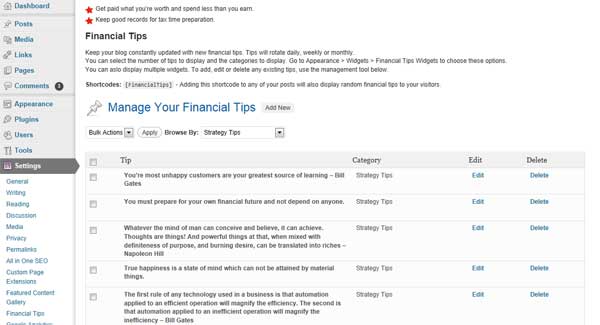
Financial Tips Plugin

The screen shot above shows the management page of the plugin. This is where can edit any existing tips or add your own tips.

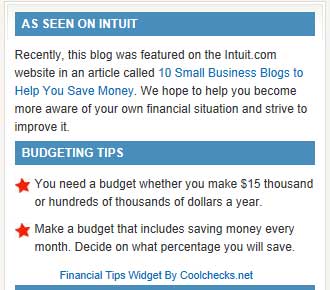
Side Bar Text Widget

The text widget can rotate your tips on a daily, weekly or monthly basis. You can also select how many tips to show and choose you the category you want. You can use more than one widget.

Please let us know if you have any trouble with getting the plugin to work for you or if you have any suggestions to make it better! To a bright outlook on your wealth building future!

Filed Under: Personal Finance Tagged With: money management, Personal Finance, WordPress

30 Personal Finance Tips To Use Now

October 29, 2012 By Sherry Tingley

Protect Yourself In This Fragile Economy

Personal finance tips can come in handy when you are trying to improve your financial situation.  Economic struggles in the past several years have really turned some people’s lives upside down.

In September, 2012, there were 12.1 million unemployed people. That’s a lot of people struggling to make ends meet any way they can.

To help you through this tough economic time, make sure that you help yourself by doing some of these practical things.

Protect yourself

  • 1. Get a credit report every year so that you can make sure your credit is in good standing.
  • 2. Scan everything in your wallet. In case of theft, you’ll have all your account numbers and contact information available.
  • 3. Stop overdraft fees by going online and hooking up your checking account with a savings account.
  • 4. Sign up for an alert that warns you when your account reaches whatever amount you choose.
  • 5. Keep well organized financial documents for tax purposes
  • 6. Diversify your sources of income.

Setting Goals

  • 7. Decide what you want to do with your money.
  • 8. Cover the necessities first
  • 9. Use free websites for tracking goal setting
  • 10. Choose some new starting points to hope for the best but plan for the worst.

Savings Strategies

  • 11. Start saving at an early age.
  • 12. Save money on a weekly basis and leave it alone for a while.
  • 13. Order free information for your vacation planning.
  • 14. For older folks, estimate your retirement benefits online at www.ssa.gov where you can put in your social security number and estimate your retirement benefits.

Debt Management

  • 15. Use your tax refund to pay off high interest credit card debt.
  • 16. Go to the websites where you have credit card accounts and sign up for an alert to remind you 10 days prior to the due date.
  • 17. Request a reduction in your credit card interest rates.
  • 18. Be grateful that your debt is not as big as the country’s debt.

Daily Living

  • 19. Take an oath of financial honesty, with yourself and with others.
  • 20. Use your local library instead of purchasing books.
  • 21. Eat at home. Avoid restaurants to limit calories and cash expenses.
  • 22. Reassess your possessions and see what you can live without.
  • 23. Tell a friend what you are saving for and ask for emotional support.
  • 24. Practice self-monitoring. Track spending using software like quicken or see if your online banking has a budgeting feature and track it for free.
  • 25. Beware of advertising campaigns to entice you to spend more on house-hold goods. Proctor & Gamble, will increase advertising expenses by 20% in 2010.
  • 26. Shop at cheaper stores. You can get Egyptian cotton sheets at discount stores.
  • 27. Recognize buying mistakes and vow not to make them again.
  • 28. Give away things you don’t need to make room for your new life.
  • 29. If you are suffering from depression about your finances, discuss it with your doctor.
  • 30. Learn to live with less – do you really need everything you have stashed away?

Your net worth to the world is usually determined by what remains after your bad habits are subtracted from your good ones.

Filed Under: Personal Finance Tagged With: money management, Personal Finance

Financing Behind Olympic Competitors

August 9, 2012 By Sherry Tingley

Personal finance skills are of utmost importance to those that train to compete in the Olympics. Gold is obviously the coveted prize at the end of the Olympics rainbow. But what some of the athletes do to earn their daily gold in between competitions shows a wide range of personal wealth — or poverty. On this year’s roster are a dentist, a bartender/bouncer, a former brothel owner and a monk, plus many with more mundane jobs, according to an Associated Press story.

The costs of training are enormous, and the time demands of training mean that earning a living has to fit a flexible schedule. In some countries, the local International Olympics Committee provides some help. Not so in the United States. The International body shares some money with the smaller organizations, but the latter get to decide what to do with it. In some places, none of it trickles down to the Olympic hopefuls.

That means some athletes end up jockeying two or more jobs — up to seven in rate instances — to pay for their training and keep themselves fed.

Before coming to the London Games this summer, Irish boxer Darren O’Neill was a teacher at Holy Trinity Primary School in Dublin. He quit before the London competition to train full-time. Will he have a job to go home to? He isn’t sure, although a hand-painted banner on the school saying “Good Luck Mr. O’Neill” is a promising sign. Bottom line: He likes boxing well enough to sacrifice the job if necessary.

When Lance Brooks, an American discus thrower, moved to Denver to start serious training five years ago, he became a bartender/bouncer and all-around bar backer, restocking shelves and taking out the trash. He also picked up cash working Denver Rockies baseball games and coaching at a local high school. He did a stint at an oil-change service and worked construction to make ends meet. Finally, his coach put the kibosh on so many jobs. Brooks had to choose to discontinue his patchy employment or lose his trainer.

Some of the Olympians combine work and training. Luca Tesconi of Italy, who won silver in 10-meter air pistol competition, is a police officer in his home town. And Kai Johnssan, a pistol shooter, is a member of Finland’s Coast Guard Air Flight Patrol.

Sometimes they get creative. Nick Symmonds, four-time U.S. outdoor track champion in the 9000-meter, went on eBay and auctioned a spot on his shoulder for $11,100, promising to sport a temporary tattoo for the highest bidder. The offer was picked up by Hanson Dodge Creative, a marketer focused on active lifestyles. Too bad. Olympic rules preclude athletes advertising brands during competition. Symmonds had to cover his billboard shoulder.

Wendy Houvenaghel had to take continuing education courses so she could go back to her career as a dentist in Northern Ireland after taking an extended break for training. She’ll go back to dentistry when the Olympics and her cycling career are over. She rides for Britain.

At the extremes are Logan Campell, a taekwondo fighter for New Zealand, who financed his training with an upscale brothel in Aukland, and Kenki Sato, a Japanese equestrian competitor, who is a monk at his family’s Buddhist Temple near Nagano. Campbell sold the brothel in 2010 (although prostitution is legal in New Zealand) when the help was provided by his the IOC and sponsors. Sato will go back to his job as monk, which he says is good for discipline.

The 2012 Olympics will end and then dozens of this year’s athletes, along with hundreds of hopefuls for Olympics future will be back to the grindstone to earn the pennies that lead to the gold.

Filed Under: Entrepreneurs, Finance Tagged With: entrepreneur, making money, Olympics, Personal Finance

  • « Go to Previous Page
  • Page 1
  • Interim pages omitted …
  • Page 22
  • Page 23
  • Page 24
  • Page 25
  • Page 26
  • Interim pages omitted …
  • Page 28
  • Go to Next Page »

Primary Sidebar

Personal Finance Articles

  • Make Saving A Priority
  • Review Your Home-Insurance Risks
  • Lowest Air Fare? Try August 28
  • Hackers Targeting Bitcoins
  • Keep Your Emergency Fund Intact

Save At Walmart

Search

Personal Finance Education

Investing Education from Morningstar.

As Seen On Intuit

Intuit.com has ranked Coolchecks.net #4 out of 10 of the best blogs to help you save money. We hope to help you become more aware of your own financial situation and strive to improve it.

Featured On Mint.com – July 2014

Mint Interview

Categories

  • Banking
    • Check Writing
    • Checking Accounts
    • Credit Cards
    • EMV Cards
    • Fees
    • Fraud
    • History
    • Student Loans
  • Best Of The Web
  • Budgets
    • Emergency Fund
    • Grocery Shopping
    • Saving Money
    • Spending Habits
  • Business
    • 3D Printing
    • Bankruptcy
    • Business Advertising
    • Business Development
    • Business Plans
    • Corportate Lessons
    • Data Mining
    • Legal Issues
    • Merchants
    • SEC
    • Security
    • Small Business Startups
  • Consumer Alerts
  • Cryptocurrency
  • Cutting Costs
  • Employment
    • best places to work
    • Careers
    • Interviews
    • Job Search
    • Top CEOs
    • Wages
  • Entrepreneurs
    • Attitudes
    • Entrepreneur Interviews
  • Featured
  • Finance
    • Automobiles
    • Credit Ratings
    • Education
    • Financial Planners
    • Foreclosures
    • Homes
    • Insurance
    • Investing
    • Mortgages
    • Personal Finance
    • Renting
    • Term Deposits
    • Travel
    • Work
  • Fraud
  • Government
  • Holidays
    • Christmas
    • Halloween
  • Internet
    • Bitcoin
    • Blogging Tips
    • Blogs, RSS and Podcasting
    • Databases
    • Facebook
    • Influence
    • marketing
    • Twitter
    • Website Reviews
    • WordPress
      • Key Words
  • Investing Basics
    • Hedge Funds
    • Investing
    • Mutual Funds
  • Life
    • Aging
    • Just For Fun
      • Punahou Alumni Corner
    • Millennials
    • Personal Health
  • Money Making Ideas
    • Affiliate Programs
    • Craigslist
    • Ebay
  • Money Management
    • Bankruptcies
    • Building Wealth
    • Child Care Costs
    • Christmas Shopping
    • Credit
      • Free Credit Report
    • Debit Cards
    • Debt
    • Debt Reduction
    • Health Insurance
    • Income
    • Inheritance
    • Interest Rates
    • Loans
    • Mortgages
    • New Years Resolutions
    • Retirement
    • Shopping Tips
    • Tax Strategies
    • Your Stories
  • Retirement
  • Self Improvement
    • Time Management
    • Work Habits
  • Shopping
    • Coupons
    • Online Shopping
  • Social Security
  • Tax Tips
  • Taxes
  • Technology
  • Trade
  • Uncategorized
  • Wealth

Best of Personal Finance Blogs

Best of BuyerZone Business Finance Blog Recipient

Personal Finance Sites We Recommend

Get personal finance advice from the people behind the top money blogs, including Wise Bread, The Simple Dollar, Mint and Nerd Wallet.

Copyright © 2026 ·Metro Pro · Genesis Framework by StudioPress · WordPress · Log in