• Skip to primary navigation
  • Skip to main content
  • Skip to primary sidebar
  • Money Management
    • Debt Reduction
    • Credit
    • Mortgages
    • Mutual Funds
    • Tax Strategies
    • Loans
  • Budgets
    • Saving Money
    • Income
  • Banking
    • Checking Accounts
    • Check Writing
    • Fraud
    • History
  • Entrepreneurs
    • Entrepreneur Interviews
    • Money Making Ideas
    • 3D Printing
  • Resources
  • Retirement
  • About
    • Privacy Policy

Personal Finance Blog

Tips And Stories To Help You With Managing Money

  • Privacy Policy
  • Saving Money In 2018
You are here: Home / Archives for Finance

Finance

Digital Wallets Replacing The Pocket Bulge

July 9, 2015 By Twila Van Leer

Smartphones are the new digital wallets.
What has happened to the traditional wallets that were a pain in the hip pocket or another item to lose in your purse? As predicted by tech gurus for years, they are being displaced by smartphones which can be digital wallets.

Even those who still rely on cash or plastic when they shop may soon succumb to the newer, more efficient digital wallets that are being offered by the tech companies.

Store-issued credit cards and store rewards programs are coming via Apple Pay and it really gets into the mobile payment services it began last fall. Google is standing by with a similar service that will enhance its smartphone options to run on its Android software. Samsung has in store for its newest Galaxy smartphones a service that it says will be accepted in more stores than either the Apple Pay or Android Pay.

The goal, according to company spokespersons, is to replace the standard wallet.

The improvements are almost ahead of the demand. Last year, some 16 million Americans used smartphones to pay for about $3.5 billion in store purchases, says eMarketer, a shopping research firm. The total includes Apple Pay purchases, PayPal and merchant-sponsored options from Starbucks, Dunkin’ Donuts and others.

Sounds big, but it’s just a small part of the $4.3 trillion Americans spent in stores last year. The researcher group expects that the digital wallet component will grow to $27.5 billion in 2016 as the option catches on with more shoppers.

The move to digital pay has been slowed by failure among the major tech providers to agree on technical standards, security measures and financial terms. And some large merchants have balked, saying they would prefer to develop their own systems.

Despite the roadblocks, Apple Pay made inroads when it was endorsed by major banks and retail firms. The system only works on the latest models of iPhones and Apple Watch. Users create a link to their iPhone with a credit card or bank account. When that has been accomplished, the user just has to hold the phone next to a device on the store counter to make a transaction. The phone and the counter device communicate wirelessly, with the purchaser authorizing payment by pressing the phone’s fingerprint sensor. No card to swipe. The user’s financial information is protected by encrypted codes.

Apple’s next update will facilitate credit purchases and allow purchasers to tap into loyalty points at major stores where they routinely shop. Agreements between the phone providers and popular shopping spots such as Walgreens will add options. Walgreens expects that in the near future, more customers will pay with smartphones or watches to tap into the stores’ Balance Rewards program. They will be able to use their loyalty points with Apple Pay. J.C. Penney stores also are banking on many iPhone shoppers opting into their store-label credit cards. The in-store credit card already is snagging more transactions than any other payment card. Customers earn points with each transaction.

Google, which has struggled to compete in the digital wallet arena, believes it will gain ground with the introduction of Android Pay, due to be released this year. Google will add store rewards, but does not plan to work with store credit cards, at least initially.

Not to be left behind in the race to digital wallet pay, Samsung Pay will also be released this fall. Its technology will work with traditional store credit card readers. Stores initiating the services from other tech companies have to invest in equipment to receive data.

The move obviously is on and pay-by-phone is here to stay.

Related articles across the web

  • Apple has filed a patent for a new feature that could kill off mobile payment apps like Venmo, Paypal, and Squarecash (AAPL)
  • Apple Pay, mobile wallets, and the future of ecommerce

    Filed Under: Personal Finance Tagged With: credit cards, Digital Wallets, money management

    Reverse Mortgages Not All Positive

    June 24, 2015 By Twila Van Leer

    Is a reverse mortgage worth it in the long run?
    Is a reverse mortgage worth it in the long run?
    Older Americans who watch television are besieged by ads that promise a reverse mortgage is the answer to all their financial problems. Often, the ads are touted by such celebrities as actor Henry Winkler, whose old Fonzi character from Happy Days still resonates with the older crowd. Or the messages are given the aura of respectability when they come from someone like Fred Thompson, a former U.S senator.

    Don’t be too quick to accept all that the ads lead you to believe, the Consumer Financial Protection Bureau warns. They may not be telling the whole story.

    The federal agency conducted a study that showed some older homeowners are increasingly complaining that they were given false impressions about reverse mortgages.

    Such mortgages are offered to people over 62, some of whom believe they are a government-sponsored benefit that will ensure that they can stay in their home until death. Not so, says the CFPB. They are loans that must be repaid – with interest. In some instances, they result in the loss of the home. Many seniors, long retired and on a fixed income, can’t afford such a financial arrangement.

    A scary 10 percent of those who take out a reverse mortgage default on the loan, about twice the rate of defaults on conventional mortgages.

    The idea of receiving cash or a line of credit that taps the equity in the home seems attractive to many cash-strapped seniors. They may see the reverse mortgage as a way to pay off debt or to remodel their older homes. They have no loan payments on a monthly basis. But over time, the loan balance increases and it comes due when the borrower dies, moves or sells the home or if it defaults on other obligations such as insurance or taxes. That may come as an unpleasant surprise to survivors.

    Most reverse mortgages are insured by the Federal Housing Administration, but they are not a risk-free benefit, something that many of the borrowers do not understand and which the ads don’t warn them of, the CFPB study showed. Too much “fine print” confuses many of the elderly and leaves them vulnerable, the agency warned. Often, they are oblivious to the fact that the loans carry interest, that there are repayment terms and other crucial requirements that may well rear up and bite those who sign on the dotted line without understanding all the relevant factors.

    As part of its review of reverse mortgage practices, the CFPB held interviews with some 60 homeowners over age 62 during focus group meetings or in individual sessions.

    Spokespersons for the National Reverse Mortgage Lenders Association, on the contrary, say that they have a code of ethics that includes a requirement for accurate advertising. The association, which presents the companies that supply reverse mortgages, says it is committed to educating consumers about the pros and cons of their product and trains lenders to be sensitive to client needs.

    Bottom line: no matter what “the Fonz” says, it is wise to make a thorough study of how reverse mortgages work and match the information very carefully with your particular financial situation before acting. It may be the lifesaver you are looking for, but it may be risky enough that you’ll want to look at other options.

    Filed Under: Money Management, Mortgages

    Couples Need To Share Financial Planning

    June 8, 2015 By Twila Van Leer

    Protect your estate by creating a valid will covering all of your assets.
    Protect your estate by creating a valid will covering all of your assets.
    When a couple has financial assets valuable enough to require estate taxes, they need to work as a team to be certain that their planning is consistent. The threshold for estate taxing is $5.43 million federally, but some states set their own limits.

    Julie Jason, a personal money manager and financial writer whose columns are syndicated, offers suggestions for couples to help them assure that their estate plan coordinates with their financial plan.

    Start With An Audit

    Included in her advice: Start with an audit of your particular situation. Don’t rely on memory. Gather relevant documents and organize them in a binder. Include wills, trusts and powers of attorney. Have copies of all beneficiary designations on tax-deferred accounts and annuities.

    Check Beneficiaries’ Information

    Document life insurance policies, along with beneficiaries to whom benefits are payable. Provide the same documentation for all real estate you own and review how the property is titled. Check your state laws to see if they allow you to designate a beneficiary on the deed to transfer the property on your death.

    List All Bank Accounts And Investment Accounts

    Have copies of bank and brokerage accounts, including Treasury bonds purchased through a bank. Don’t overlook mutual funds and annuity statements. Check to see if any of the accounts contain provisions to “transfer on death” or “payable on death” or “in trust for.”

    Make copies of stock certificates. Often, on death of the owners, those who inherit don’t know where the original certificates are located. Again, check for the above notations that would determine how the stocks are to be assigned.

    If you are a business owner, have copies of stock certificates if you are organized as a corporation. If it is a partnership, copies of the operating agreement are necessary. Also include titles to vehicles. And check to see if your state is one that allows you to pass the title to a beneficiary without going through probate.

    Valuable Art And Collectibles Need Proof Of Purchase

    Proof of purchase of art and collectible items should be in your record and copies of your most recent tax returns also should be in the folder. A current list of all liabilities, including outstanding debt and mortgages on real estate, is necessary. Also list all safety deposit boxes you use.

    When all the relevant information is gathered into one place, go through it and note whether items are owned by the husband or wife or jointly. Prepare lists based on ownership. A spreadsheet is useful for organizing the information. Add information showing how you intend items to be dispersed in the event of the passing of either partner.

    This kind of joint organization will spare heirs and legal advisors a lot of headaches when death occurs.

    Related articles across the web

    • 8 Estate-Planning Documents You Need Right Now
    • Couples & Money: Ours? His? Hers?
    • Your Will And Trusts Aren’t Enough: Using Beneficiary Designations As An Estate Plan

      Filed Under: Personal Finance Tagged With: Personal Finance

      Do Women Shy Away From Financial Advice?

      February 18, 2015 By Twila Van Leer

      The top 100 Financial Women Financial Advisors are listed at the Barron website
      The top 100 Financial Women Financial Advisors are listed at the Barron website
      Women control two-thirds of the private wealth in America, but financial advisors can’t seem to get the females to be interested enough to seek their advice.

      The experts expect private wealth in the country to rise from $14 trillion to $22 trillion over the next five years, with women in control of two thirds of that amount. But during a recent conference of financial advisors, they agreed that “We’re doing a horrible job working with women as a whole,” according to the publicly aired conference report.

      In the past, males largely dominated the management of family finances, but roles have been undergoing alterations over recent decades. In 40 percent of American households today, women are the breadwinners. A lingering perception that financial advisors cater more to men has been a deterrent, the experts agreed. And studies show that the perception is based on fact, they said.

      Even when couples seek financial advice, men are the primary contact in 58 percent of cases, the studies say. Many women who find themselves widowed do not continue the relationship their late husband had with a financial expert. Seventy percent of the widows no longer seek advice after the first year.

      An imbalance between males and females in the ranks of financial advisors is a significant factor. Only 30 percent of those in the field are women. Most women seeking advice say they would prefer to work with a woman. Although basic goals among advisors is the same, males approach financial planning differently from women. Females tend to put more emphasis on empathy and education when they seek advice and feel more comfortable with an advisor who shares those values. One of the top 100 female financial advisors, Karen McDonald, works for Morgan Stanley and she controls $21.2 billion dollars worth of assets.

      Some large financial advising companies are catching on and hiring more women to deal with their female customers. That sometimes means working around the employee’s home and family demands, said Cathy Curtis, who is a certified financial planner for a large firm. She does her job while rearing a family of four children. But when women advisors can be accommodated, there are overall benefits for the workplace, she said.

      The industry is making adjustments, taking pains to let women know of opportunities in the field and then trying for balance in their staffs. With two-thirds of the private wealth in the country as incentive, they are making inroads into the problem of bringing good advice to women clients.

      Filed Under: Finance Tagged With: Personal Finance

      Consumer Confidence Hits A High

      February 16, 2015 By Twila Van Leer

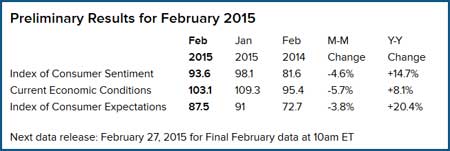
      Sentiment Index was still higher than any other time since January 2007.
      Sentiment Index was still higher than any other time since January 2007.
      Americans are feeling more relaxed about the economy, according to the Thomson Reuters/University of Michigan Consumer Sentiment Index (CSI). In January, the survey posted the highest level of confidence since 2004, before the Great Recession sent the country into a nosedive.

      The CSI is an important measure that Investors, retailers and economists use to help determine what they will do next. When people are feeling good about the economy, the index rises and the economy gets a boost. Between 2005 and 2014, the monthly index averaged 77.1. The reading for December 2014 was 93.6 and the January 2015 reading was 98.1. Since July of 2014, the index has improved by 20 percent. Economists are encouraged by the fact that that the confidence level rose in households with income under $75,000, as well as in those with higher incomes.

      At the root of the improved confidence levels are signs that the effects of the Great Recession are beginning to wane. Higher employment rates, small increases in wages and lower gasoline prices are among the factors.

      Economic prognosticators, however, remain cautious, predicting that the gains will be slow, if steady. Most workers are expecting only modest gains in income over the next five years, so spending increases also will be moderate. Shoppers are likely to look for big price discounts before they will be convinced to buy, and that contributes to dis-inflationary pressure, the experts say.

      Despite the cautious approach to predictions for this year, the signs all indicate that the country is regaining its economic equilibrium.

      Filed Under: Finance Tagged With: economy

      • « Go to Previous Page
      • Page 1
      • Interim pages omitted …
      • Page 18
      • Page 19
      • Page 20
      • Page 21
      • Page 22
      • Interim pages omitted …
      • Page 28
      • Go to Next Page »

      Primary Sidebar

      Personal Finance Articles

      • Make Saving A Priority
      • Review Your Home-Insurance Risks
      • Lowest Air Fare? Try August 28
      • Hackers Targeting Bitcoins
      • Keep Your Emergency Fund Intact

      Save At Walmart

      Search

      Personal Finance Education

      Investing Education from Morningstar.

      As Seen On Intuit

      Intuit.com has ranked Coolchecks.net #4 out of 10 of the best blogs to help you save money. We hope to help you become more aware of your own financial situation and strive to improve it.

      Featured On Mint.com – July 2014

      Mint Interview

      Categories

      • Banking
        • Check Writing
        • Checking Accounts
        • Credit Cards
        • EMV Cards
        • Fees
        • Fraud
        • History
        • Student Loans
      • Best Of The Web
      • Budgets
        • Emergency Fund
        • Grocery Shopping
        • Saving Money
        • Spending Habits
      • Business
        • 3D Printing
        • Bankruptcy
        • Business Advertising
        • Business Development
        • Business Plans
        • Corportate Lessons
        • Data Mining
        • Legal Issues
        • Merchants
        • SEC
        • Security
        • Small Business Startups
      • Consumer Alerts
      • Cryptocurrency
      • Cutting Costs
      • Employment
        • best places to work
        • Careers
        • Interviews
        • Job Search
        • Top CEOs
        • Wages
      • Entrepreneurs
        • Attitudes
        • Entrepreneur Interviews
      • Featured
      • Finance
        • Automobiles
        • Credit Ratings
        • Education
        • Financial Planners
        • Foreclosures
        • Homes
        • Insurance
        • Investing
        • Mortgages
        • Personal Finance
        • Renting
        • Term Deposits
        • Travel
        • Work
      • Fraud
      • Government
      • Holidays
        • Christmas
        • Halloween
      • Internet
        • Bitcoin
        • Blogging Tips
        • Blogs, RSS and Podcasting
        • Databases
        • Facebook
        • Influence
        • marketing
        • Twitter
        • Website Reviews
        • WordPress
          • Key Words
      • Investing Basics
        • Hedge Funds
        • Investing
        • Mutual Funds
      • Life
        • Aging
        • Just For Fun
          • Punahou Alumni Corner
        • Millennials
        • Personal Health
      • Money Making Ideas
        • Affiliate Programs
        • Craigslist
        • Ebay
      • Money Management
        • Bankruptcies
        • Building Wealth
        • Child Care Costs
        • Christmas Shopping
        • Credit
          • Free Credit Report
        • Debit Cards
        • Debt
        • Debt Reduction
        • Health Insurance
        • Income
        • Inheritance
        • Interest Rates
        • Loans
        • Mortgages
        • New Years Resolutions
        • Retirement
        • Shopping Tips
        • Tax Strategies
        • Your Stories
      • Retirement
      • Self Improvement
        • Time Management
        • Work Habits
      • Shopping
        • Coupons
        • Online Shopping
      • Social Security
      • Tax Tips
      • Taxes
      • Technology
      • Trade
      • Uncategorized
      • Wealth

      Best of Personal Finance Blogs

      Best of BuyerZone Business Finance Blog Recipient

      Personal Finance Sites We Recommend

      Get personal finance advice from the people behind the top money blogs, including Wise Bread, The Simple Dollar, Mint and Nerd Wallet.

      Copyright © 2026 ·Metro Pro · Genesis Framework by StudioPress · WordPress · Log in