• Skip to primary navigation
  • Skip to main content
  • Skip to primary sidebar
  • Money Management
    • Debt Reduction
    • Credit
    • Mortgages
    • Mutual Funds
    • Tax Strategies
    • Loans
  • Budgets
    • Saving Money
    • Income
  • Banking
    • Checking Accounts
    • Check Writing
    • Fraud
    • History
  • Entrepreneurs
    • Entrepreneur Interviews
    • Money Making Ideas
    • 3D Printing
  • Resources
  • Retirement
  • About
    • Privacy Policy

Personal Finance Blog

Tips And Stories To Help You With Managing Money

  • Privacy Policy
  • Saving Money In 2018
You are here: Home / Archives for Banking

Banking

Banking Goes Way Back

October 25, 2012 By Sherry Tingley

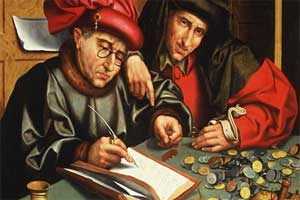
Banks are such a staple of modern life that it’s hard to imagine a time when there wasn’t one on every corner or checking accounts. And in fact, the history of banking does go back a long way — to thousands of years BCE.

Finding a way to safeguard one’s resources has been a priority from the time when barter emerged as a way to do business. The history of banking parallels that of the history of money (or the goods that were traded before there were coins and other forms of money.) Some 9,000 years before the current calendar became a world standard, folks were trading in obsidian, the prime building material for tools. And rudimentary banking grew up along with trade. Ancient bankers loaned grain to clients who were active in trade. Among the first “coins” to be discovered were clay “tokens” found in the Near East that dated back to 8000 BCE.

When one of the early traders received pay for his goods, he went to the local temple to store his gains, trusting to the god to whom the temple was dedicated to protect his assets. The ruling class used the temples to protect the funds they amassed to finance festivals and community building projects.

Ancient bankers in Egypt, Babylonia ad Greece made loans, at very high interest, underwritten by the gold and silver deposited with them.

Any banking service has always come at a cost. In Babylonia circa 2000 BCE, depositors paid as much as a sixth of their deposit in charges. And regulation was also an early issue. The Code of Hammurabi, an important source of information about the Babylonian civilization, refers to banking regulations.

New ways of counting evolved as the number and the value of the goods trusted to the temples grew. The abacus was one of the first “adding machines” used by “accountants.” Its origin is lost in history. Counting tables with special apparatus to divide and number coins followed.

By about 2000 BCE, banks had taken on some of the character of today’s institutions. In Assyria and Babylonia, bankers innovated by accepting deposits and making loans. In China and India, archaeological remains show evidence of the same activities.

Bankers in northern Italy led developments in Europe, with Amsterdam soon stepping up as a leader in the business in the 16th century. London caught on and began offering banking services in the 1700s. Even earlier, in the 14th century, two families in Florence, Italy, the Bardis and Peruzzis, dominated the banking business, opening branch offices in many large European cities. The Medici family, which is noted for its involvement in the arts and sciences of the era, also had a finger in the banking pie. Giovanni Medici established a bank in 1397.

In the Medieval world, bankers often were Jews. Christians, based on strict reading of laws against usury that were set out in the Bible, left the industry to the Jews, who were happy to have the privilege, since many other occupations were denied them.

The first bank in the American colonies was the Bank of North America in Philadelphia, chartered in the mid-1700s. Many notable families have made their names and vast fortunes in banking, among them the Rockefellers, the Rothschilds and the Morgans.

Inevitable in any business that is steeped in the care and keeping of valuables, there have been incidences throughout history of misuse of funds, frauds, robberies and failures. Even with the modern technology that facilitates the care and keeping of assets, it still happens. The most recent in the United States occurred in 2000, when some of the country’s largest financial institutions came upon hard times.

But historically, the need for safe places to keep one’s assets has been proved. Banks are here to stay.

Filed Under: Banking, History Tagged With: Checking Accounts

Using Checks Is Part Of The Earliest American Traditions

October 22, 2012 By Twila Van Leer

When the first emigrants from England began settling along the eastern seaboard of what would become America, they brought with them some of the banking practices they had enjoyed in their homeland.

Making payments and conducting business with checks had become a firmly established part of European economics by the 18th century. From 1760 to 1800, the number of banks in London, for instance, doubled. Parliament finally gave permission for new corporate banks in the city in 1833, increasing the number of options available to residents, according to a history of check use, compiled by the Federal Reserve Bank of Atlanta.

When the American colonies began flexing their financial muscles, British political leaders began to impose difficult policies on the upstart new country, suppressing banks so that the colonists could use neither checks nor banknotes. The colonies were prohibited from issuing paper money, adding to the grievances that ultimately led to the Revolutionary War. But what followed the successful fight for independence was a hodge-podge of financial schemes developed independently by the individual colonies. The new country wrestled with the notions of central monetary control vs. the rights of the states to conduct their own economic affairs.

The U.S. Constitution was finally accepted by the colonies, denied the individual states the right to issue paper money, but gave them the ability to charter banks. Over the first few decades, the central government created some oversight authority by creating the First Bank of the United States, followed by the Second Bank of the United States. They failed to survive when early presidents saw them as symbols of British-style concentration of moneyed power.

The rapid expansion of the United States, with the frontier constantly moving farther west, created new challenges, particularly for those who wanted to conduct long-distance business. Newly established communities tended to be small and geographically isolated. Collecting on a check was difficult and costly. It was possible to negotiate a check, but no third parties were anxious to buy them because it was so tough to collect. “Documentary bills” became one method of expediting business from one area of the country to another. For instance, a cotton merchant in New Orleans could borrow money or make purchases in the southern city by drawing a documentary bill on his wholesaler in New York. A bill of lading would be attached to a shipment of goods to the north, indicating that the southern merchant had shipped cotton to New York of a value sufficient to cover the amount of the bill.

As some cities grew, their state–chartered banks created cooperative alliances with institutions in other cities, which facilitated the use of checks. Until the Civil War, however, checks functioned only as a local form of payment. Improvements in transportation and communication contributed to easing the difficulties and long-distance check payments gradually grew. Still, complications were rife. In one instance, a check drawn on a bank in Sag Harbor, New York, and received in Hoboken, N. J., changed hands ten times before its collection was finalized. The distance between the two communities was only about 100 miles. A remittance charge or exchange charge was often added to the costs of negotiating a check, to cover the cost incurred by the paying bank, which had to ship currency or coin or use some other means for settling the negotiation. One researcher referred to this era of check use in the United States as a “Haphazard arrangement riddled with inefficiencies.”

The National Banking Acts of 1863, 1864 and 1865 went a long way toward resolving the troublesome issues that surrounded use of checks. They allowed for federally chartered banks and took significant steps toward assuring that banks were fiscally sound by requiring that they hold reserves equal to the deposits they were receiving. The groundwork was laid for a national check clearing system and correspondent networks were created to simplify transfers of funds.

With more safeguards in place and fewer complications in successfully negotiating a check, the United States moved by degrees to its current situation in which check use is not for business only, but for the vast majority of individuals, who write checks with never a thought to how it all came about.

Filed Under: History Tagged With: Checking Accounts

Use Of Checks Began In The Middle East

October 18, 2012 By Sherry Tingley

Paying by check has been such a pervasive American custom that you might suppose the idea started here. Not so. The history of the use of checks to pay for goods or services goes back more some 2,000 years.

The word “check,” in fact, may have evolved from the Persian word “sakk,” according to a history of check use compiled by the Federal Reserve Bank of Atlanta. The report opens with a story of an Iranian traveler, Nasir-i Khosrau, who visited the ancient city of Basra (in present-day Iraq), in the early eleventh century. While in Basra, Khosrau, a merchant, gave written instructions to his bank to make a payment to a creditor out of his account.

Although this recorded story is one of the first substantial evidences of the use of checking, it had already been a well-established practice in the eastern Mediterranean area for hundreds of years. Crusaders who marched on the Middle East hoping to reclaim Christian sites became acquainted with the system and carried the notion back to Europe, which had extremely primitive monetary systems by contrast. The still-evolving nations of the Continent had few coins of reliable value, no banks and few notions of how to conduct long-distance transactions, let alone local trade.

Barcelona, Florence, Genoa and Venice — large commercial centers of the 13th Century — were among the bellwether communities to establish rudimentary banks to facilitate payments among local merchants. But the process was clumsy. It required that the payor and payee both walk to the payor’s bank, where an oral order was presented to the banker requesting that the required amount be paid to the payee. The banker then duly made a record of the transaction in his journal.

The payee was willing to go to the trouble, because the coinage of the era was very unreliable and large amounts of coins were heavy and awkward to deal with. Occasionally the banker would allow the client to overdraw the account, another innovation to facilitate commerce.

Written orders to transfer funds were viewed with distrust because of the possibility of fraud on the part of payor, payee or even the banker. When all three parties were required to be present, each had at least two eye witnesses to the deal.

In the Middle Ages, banks were locally chartered and could handle transactions only in their own towns. Bills of exchange became a common method of doing business, with the bill written in one city but paid in another through a cumbersome process of moving funds from one bank to the other. As the systems became more sophisticated, checks became more common.

Checks began to appear in Europe about 1400, but it took time for banks to accept that form of transaction. There was widespread distrust among banks in general, but over time, convenience trumped the lingering concerns and checking became more entrenched, despite fraud and abuses.

Use of checks was firmly established in England when the American colonies were established and — with many circuitous stops, starts and enactment of laws primarily aimed at oversight — the emergent United States took up, improved on and firmly adopted the custom. In 2006, according to the Federal Reserve System, Americans wrote some 33 billion checks.

Filed Under: Check Writing Tagged With: Checking Accounts

Protect Yourself Against Check Fraud

August 6, 2012 By Sherry Tingley

Check fraud is such a hot topic that Hollywood made a movie about it. The 2002 film, “Catch Me If You Can,” starred Leonardo DiCaprio as master fraud artist Frank Abagnale and Tom Hanks as the FBI agent who chased him all over the world. It was filmdom’s way of putting the spotlight on a problem that plagues real-life personal finances.

In the movie, DiCaprio’s character flitted across the United States and around the world using such cover as pediatrician, airline pilot, attorney and college professor to gouge a grand total of some $2.5 million out of unwary victims. He was caught, both in the movie and in real life, and spent five years in prison. Part of the agreement that set him free after such a relatively short term was that he would help the feds to combat the types of crimes he had himself so successfully perpetrated.

The switch from bad guy to good guy set him up as an authority and his crime prevention programs have been used by more than 14,000 companies, law enforcement agencies and financial institutions to protect their interests and those of the people they serve.

In an interview with U. S. News, Abagnale shared five tips for individuals to protect themselves against check fraud. Here they are:

1. Write as few checks as you can. The standard check provides such information as your name, address, often a phone number, sometimes your driver’s license number (In nine states such information is required by law, giving a fraudster near-direct access to your Social Security Number as well), the bank account number and routing number and a nice signature should he have a desire to replicate it. Use checks for making mortgage payments and paying bills, but be very chary of other uses. If someone wants to sell you a product at the door, use cash, don’t give him or her a tool to use against you.

2. Take special care at tax time. Ninety percent of those who owe Uncle Sam use a check to pay up and seasoned fraudsters are on the alert for such easily identifiable letters in your outgoing mail. They have only to modify the payee information and deposit. That benefits a criminal and puts you in hot water with the IRS.

3. Use secure mailboxes. Putting bill payments and other letters containing checks into the box at the curb or outside your door, then putting the flag up to alert the postman is an open invitation to anyone bent on fraud who happens to notice. Go to a post office or put the letters in a secured box for collection.

4. Treat checks and checkbooks like cash. Lock them in a safe place. Some people like the convenience of having some checks in the glove compartment of their car. It’s the first place people looking for money, credit cards, gas cards and/or receipts with your information on them will look. The smart ones will remove only the last check or two from a book, giving themselves time to use the checks before you notice you have any missing.

5. Balance your checkbook every month. It’s only common sense, but 51 percent of Americans don’t do it. Many fail even to open the statement and check the bottom lines. That gives banks an advantage in assigning responsibility — the criterion by which they decide if they will compensate you or let you eat the loss yourself. A federal law, Article 3, Section 406 of the Uniform Commercial Code requires that you notify your bank within 30 days of any discrepancies. If you don’t do it, the bank has no liability.

All good advice from someone who knows.

Filed Under: Checking Accounts, Fraud Tagged With: Check Fraud, Checking Accounts

Check Fraud Is A Serious Matter in U.S.

August 4, 2012 By Sherry Tingley

Just how serious a problem is check fraud in this country? Well, put it just behind payment card fraud and ahead of phishing. The total losses are staggering, — $5 billion a year, according to the U.S, Secret Service.

The chief of the Secret Service’s financial crimes division calls it “the number one way criminals today are attacking our financial systems.” That means you need to know more about the problem and take steps to protect your checking account.

The statistics are chilling. The 2012 AFP Payments Fraud and Control survey of more than 5,000 corporations received 447 responses. Among the things they had to say:

Checks are the payment type most vulnerable to fraud.

The typical loss for the organizations that reported fraud was $19,200.

85 percent of those responding to the survey say check fraud is a problem.

More than 80 percent of the companies had “best practices” policies in place, but still lost money to fraud because they failed to follow their own policies. Sadly, according the American Banker’s figures, some 60 percent of the fraud incidents involve employees within the business.

American Banking Association’s Deposit Account Fraud survey in 2011 showed a loss totaling $893 million in 2010 among the institutions surveyed. In that year, attempted check fraud against bank deposit accounts amounted to some $11 billion. The figure reflects both actual losses and loss avoidance due to banks’ prevention efforts. Although slightly lower than the $11.4 billion posted in 2008, the figures are still appalling.

The steps banks must take to prevent fraud are costly as well, according to the ABA survey. Four “money center” sized banks said they spent more than $20 million each for fraud-related programs, not including actual losses that slipped through their prevention nets. Regional banks reported losses of a half million to a million, while mid-sized banks reported losses ranging from $R50,000 to $250,000. Community banks averaged $5,000.

It isn’t encouraging to know that the scope of the problem continues to expand. The ABA data show that the per-incidence cost of fraud have doubled in the past six years, even though more individuals and businesses are switching to electronic transfers to pay bills. The actual volume of check use had fallen by 26 percent, but the ill effects of fraud continued to climb. Even with the decline in check use, 80 percent of business-to-business transactions are consummated by check and financial experts say that trend will continue through the foreseeable future. The advantages simply make paying by check preferable.

Your bank is likely to have information about how you can protect your account. They can explain their polices regarding responsibility when fraud occurs. Many check printing companies are stepping up to make checks more fraud-proof. They incorporate such features as safety holograms, multi-dimensional foil seals hot-stamped to check stock. They can’t be photocopied. Chemically sensitive paper, micro-print borders, invisible fluorescent fibers, erasure protection, security screens and warning boxes are all innovative approaches available to businesses to help ensure check safety.

Don’t just look at the statistics and shudder. Take pro-active steps to make sure you don’t join the long lists of fraud victims.

Filed Under: Banking, Fraud Tagged With: Checking Accounts, Fraud Prevention

  • « Go to Previous Page
  • Page 1
  • Interim pages omitted …
  • Page 7
  • Page 8
  • Page 9
  • Page 10
  • Page 11
  • Interim pages omitted …
  • Page 13
  • Go to Next Page »

Primary Sidebar

Personal Finance Articles

  • Make Saving A Priority
  • Review Your Home-Insurance Risks
  • Lowest Air Fare? Try August 28
  • Hackers Targeting Bitcoins
  • Keep Your Emergency Fund Intact

Save At Walmart

Search

Personal Finance Education

Investing Education from Morningstar.

As Seen On Intuit

Intuit.com has ranked Coolchecks.net #4 out of 10 of the best blogs to help you save money. We hope to help you become more aware of your own financial situation and strive to improve it.

Featured On Mint.com – July 2014

Mint Interview

Categories

  • Banking
    • Check Writing
    • Checking Accounts
    • Credit Cards
    • EMV Cards
    • Fees
    • Fraud
    • History
    • Student Loans
  • Best Of The Web
  • Budgets
    • Emergency Fund
    • Grocery Shopping
    • Saving Money
    • Spending Habits
  • Business
    • 3D Printing
    • Bankruptcy
    • Business Advertising
    • Business Development
    • Business Plans
    • Corportate Lessons
    • Data Mining
    • Legal Issues
    • Merchants
    • SEC
    • Security
    • Small Business Startups
  • Consumer Alerts
  • Cryptocurrency
  • Cutting Costs
  • Employment
    • best places to work
    • Careers
    • Interviews
    • Job Search
    • Top CEOs
    • Wages
  • Entrepreneurs
    • Attitudes
    • Entrepreneur Interviews
  • Featured
  • Finance
    • Automobiles
    • Credit Ratings
    • Education
    • Financial Planners
    • Foreclosures
    • Homes
    • Insurance
    • Investing
    • Mortgages
    • Personal Finance
    • Renting
    • Term Deposits
    • Travel
    • Work
  • Fraud
  • Government
  • Holidays
    • Christmas
    • Halloween
  • Internet
    • Bitcoin
    • Blogging Tips
    • Blogs, RSS and Podcasting
    • Databases
    • Facebook
    • Influence
    • marketing
    • Twitter
    • Website Reviews
    • WordPress
      • Key Words
  • Investing Basics
    • Hedge Funds
    • Investing
    • Mutual Funds
  • Life
    • Aging
    • Just For Fun
      • Punahou Alumni Corner
    • Millennials
    • Personal Health
  • Money Making Ideas
    • Affiliate Programs
    • Craigslist
    • Ebay
  • Money Management
    • Bankruptcies
    • Building Wealth
    • Child Care Costs
    • Christmas Shopping
    • Credit
      • Free Credit Report
    • Debit Cards
    • Debt
    • Debt Reduction
    • Health Insurance
    • Income
    • Inheritance
    • Interest Rates
    • Loans
    • Mortgages
    • New Years Resolutions
    • Retirement
    • Shopping Tips
    • Tax Strategies
    • Your Stories
  • Retirement
  • Self Improvement
    • Time Management
    • Work Habits
  • Shopping
    • Coupons
    • Online Shopping
  • Social Security
  • Tax Tips
  • Taxes
  • Technology
  • Trade
  • Uncategorized
  • Wealth

Best of Personal Finance Blogs

Best of BuyerZone Business Finance Blog Recipient

Personal Finance Sites We Recommend

Get personal finance advice from the people behind the top money blogs, including Wise Bread, The Simple Dollar, Mint and Nerd Wallet.

Copyright © 2026 ·Metro Pro · Genesis Framework by StudioPress · WordPress · Log in