• Skip to primary navigation
  • Skip to main content
  • Skip to primary sidebar
  • Money Management
    • Debt Reduction
    • Credit
    • Mortgages
    • Mutual Funds
    • Tax Strategies
    • Loans
  • Budgets
    • Saving Money
    • Income
  • Banking
    • Checking Accounts
    • Check Writing
    • Fraud
    • History
  • Entrepreneurs
    • Entrepreneur Interviews
    • Money Making Ideas
    • 3D Printing
  • Resources
  • Retirement
  • About
    • Privacy Policy

Personal Finance Blog

Tips And Stories To Help You With Managing Money

  • Privacy Policy
  • Saving Money In 2018
You are here: Home / Archives for 2010

Archives for 2010

The Value of Scarcity and Uniqueness in Business

April 14, 2010 By Sherry Tingley

Auctions can bring hefty prices for unique, rare items. Recently, a manual typewriter fetched the amount of $254,000.

Why the astronomical price? You may wonder about this because living in the digital age, who needs a typewriter?

Possibly similar to the sale of one of Michael Jackson’s glove, this memorabilia belonged to Cormac McCarthy, American fiction writer. From this humble looking typewriter, McCarthy typed more than 5 million words over a period of 50 years.
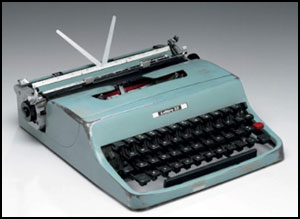
The Lettera 32 Olivetti Typewriter

Cormac McCarthy, born in 1933, is an American novelist and playwright sometimes compared to Faulkner. Six of his novels were made into films. Well known for his 2007, Pulitzer prize winning, work of fiction called, “The Road.”

In 2008, McCarthy was awarded the Pen/Saul Bellow Award for Achievement in American Fiction. His work was recognized for qualities of excellence, ambition and scale of achievement during his writing career. This places him in the highest ranks of American literature.

People predicted his typewriter may go for $18K or so. Those predictions were far below the price it received. The large sum of money was donated to a scientific research organization, the Santa Fe Institute.

The qualities of uniqueness combined with scarcity can drive up the value of an item exponentially. With many competing businesses in similar niches popping up all over the web, thousands will collapse and a few will prosper. It seems to be a natural cycle of business.

If you want your Internet business to prosper, ask yourself if you have something to offer people that is both unique and scarce. The more you can meet this criteria, the better your business will do. What can you bring to the table that is different from every other company? Opportunities to create new, unique products are endless.

The entrepreneur in us sees opportunities everywhere we look, but many people see only problems everywhere they look. The entrepreneur in us is more concerned with discriminating between opportunities than he or she is with failing to see the opportunities. ~Michael Gerber


Filed Under: Business Development Tagged With: business, cormac mccarthy, entrepreneur, Money Making Ideas, typewriter auction

How To Use Flickr Photos On Your Blog

April 8, 2010 By Sherry Tingley

Using photos from flickr.com on your blog can make your writing come to life and provide your readers an exceptional experience. The photo above taken from the seat of a motorcycle, heading for the Eifel Tower, is just an outstanding photo. It makes you wish you were there. The old adage that a picture is worth a thousand words really is true.

To get started, you’ll need to go to flickr.com and sign up for a free account. There are paid accounts with a small yearly fee of $24.95 which will allow you to upload your pictures for distribution.

Once you have signed up with flickr, you will find that there are over 139,726,734 photographs available for your use in the area called the Creative Commons.

These photographs have been given the CreativeCommons.org license which gives you permission to use these photos with a few restrictions. You receive worldwide, royalty free, permission to use the photographs indefinitely.

There are restrictions to the way you can use the photos that are reasonable and that you must agree to.

Here are the rules you must follow:

1. You must attribute the photograph to the owner in the manner that the owner sets on the photograph. You can find that information on the bottom right hand side of the page that the individual photo is on. Basically you use their name and title of the photo.

2. You can’t use the photos for monetary gain. For example, you can’t download the photos and make calendars out of them to sell.

3. You may not collect any royalties on the photos.

4. You may not distort the photo in anyway. So Photoshop editing is not allowed.

5. You must include the URI for the license with every copy of the work you distribute. This is the copy of the license so that you can read the license in it’s entirety: Creative Commons License.

In your search for the right photograph for your story, you can see the most popular image topics that people have been posting in the past 24 hours, 7 days and since the beginning of flickr.

There is also a service called “Blog This” where you can find a photo and just click on blog this. Type your story directly on the same page that the photo is and push a button and it will post it to your blog. You’ll need to register your blog with them so that logging in to your site and posting can be done quickly and easily. The photo will be inserted into your post like the photo in this story was inserted.

Make your blogging more interesting by adding photographs from all over the world. You’ll learn what type of camera took each photograph and you’ll be adding a little BAZINGA to your story.

Filed Under: Blogging Tips Tagged With: blogging, flickr, photographs

Behavioral Finance Experts Share Tips

April 5, 2010 By Sherry Tingley

Are you one of the 50% of Americans that don’t expect your personal finances to improve in the next six months? According to a recent Harris Poll 30% of Americans feel that their finances will worsen. Fear of losing your job or losing money influences us tremendously.

Emotional Financial Decisions

There have been studies done by behavioral finance experts that say by nature we seem to look at our own situations as worse than they actually are. Is that true for you? One solution to this problem is to figure out how to conquer the emotions that stop you from making the best financial decisions you can.

What are you risking?

Psychologists often use the phrase, “The emotional tail wags the rational dog.” The same is true for us in managing our personal finances. So what can you do to help yourself?

The first thing to do is to save money and save money early. A gentleman was discharged from the Army in 1958 with a check for $3,500. He got some advice from the head of research at Smith Barney about what to do with his money. He was advised to save it and invest it. He ended up investing the entire amount in IBM stock because he was familiar with the company. That stock is now worth over a quarter of a million dollars.

Why Is It Hard  To Save Money?

Richard Thaler, author of the bestselling book,”Nudge,” and professor at the University of Chicago, School of Business, says that the biggest problem Americans have is just not saving enough money. It is recommended that you save ten percent of your income, but many people fall far short of that. He says that people are not perfect. We all make mistakes. Figuring out how your emotions are getting in your way of saving will go a long ways in helping you get your finances back on track.

David Laibson, an economics professor at Harvard reports that the reason that people don’t save is primarily due to procrastination. They don’t want to fill out the paperwork that would make automatic payments into a savings plan. They decide that they’ll do it next week. It’s very similar to putting off a diet. It’s much easier to start on Monday. Do something about putting a savings plan in place. Use a strategy like saving ten percent of your income and put it on auto pilot.

Can you imagine how it would feel to have done this consistently throughout your life time? Warren Buffet, the third richest person in the world, worth $47 billion dollars, keeps $20 billion dollars in cash on hand. It helps him sleep at night.

Steps You Can Take Now

Your area of focus should be on building an emergency fund that will carry you through three to six months of unemployment. Try to eliminate big money expenses that may be unnecessary. Start networking with others before you lose your job. Find organizations to join where you can network at least once a week. Seventy-three percent of six-figure earners landed their current positions through personal contacts.

Get your finances back on track by saving on a regular basis, making good financial decisions without undue emotional factors and do yourself a favor by networking with others like-minded business people on a regular basis.

Filed Under: Saving Money Tagged With: Personal Finance, save money, Saving Money

Debt-Free On Any Income

March 31, 2010 By Sherry Tingley

Financial security may be hard to imagine for a lot of people. To acquire this type of security means that you will have to make sacrifices to achieve debt free living. If you have gotten yourself into debt for medical reasons, lost jobs, over speculating or even the bitter sweet problem of self indulgence, then you will need to find a way to crawl out from the burden of debt.

Not what you were expecting?

Debt has two faces. One face is called good debt. Good debt is for purchases like housing or schooling that will increase in value over time. The other face of debt is ugly. It’s consumer debt on credit cards that have interest rates that are not tax deductible and can rise over time.

Many books have been written about getting out of debt, which most agree that they want to do. Some dream that they want to become debt free and some people actually do become debt free.

Lyle and Tracy Shamo have written a book called, “Debt-Free On Any Income.” It has an excel spreadsheet program that can help you list all of your debt and pay it down systematically. This is a good system to use and will help you get out of debt.

Let’s say you have four credit cards that have a variety of debt on them. Say for example the balances are $7,540, $238, $4,333, and $1,980. You are looking at a $14,091 debt. That should be enough to wake you up that you need a better payoff plan.

One way to tackle this debt is to make the minimum payments on each account. Then you are easily looking at a very long time before you’ll be debt free, but your credit score will stay intact. Say you decide that you are going to use $200 every month to pay towards your credit card debt. You would want to take the $238.00 debt and put money towards paying off that amount.

When you are done with that bill, you use the same $200 and put it towards the $1,980 debt until it is paid off. Theoretically you should now have more than $200 to put towards your monthly debt. Not having the minimum payment for these two bills could free up maybe $75 a month. So now you can put $275 a month toward your $4,333 bill. As you continue doing this, your monthly minimum payments will go down and the amount you can put towards your debt payoff will go up. By the time you are solely focusing on the largest debt, you’ll have more to pay that off every month.

The key to this plan though is to not incur more debt at the same time you are doing this. Basically you need to decide to quit spending money that is not in your bank account. When that becomes a lifelong habit, you won’t have to face these problems again and again.

The Bank of America/MBNA has issued credit cards and consumer debt they report is $194.70 billion. This includes the U.S., Spain, Canada, Ireland and the U.K. The average credit card debt per household is $16,007, according to CreditCard.com.

All of us can use a little help in controlling consumer debt and living a debt-free lifestyle. Practice using the payoff techniques and the spending rules and it won’t be long before you are on your way to becoming debt free.

Filed Under: Debt, Debt Reduction, Money Management Tagged With: consumer debt, debt free, good debt, money management

Overdraft Bank Fees Limited

March 23, 2010 By Sherry Tingley

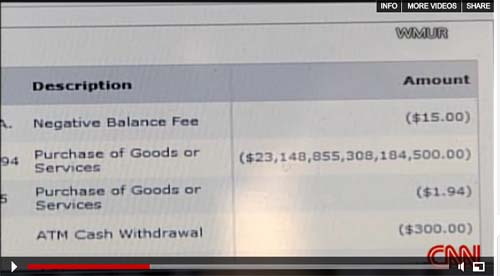
Overdraft bank fees are frustrating, annoying and can make you feel like you’ve been robbed. In one incident, a New Hampshire man, Josh Muszynski bought a pack of cigarettes from a local gas station. Later that day, he logged on to his bank account and was shocked to see a 23 quadrillion dollar overdraft ($23,148,855,308,184,500)! Josh thought that his account had been comprised and that someone had bought Europe with his card! He didn’t know what could cause that to happen. The bank, unable to account for the error, fortunately reversed the huge charge within 24 hours.

Josh Muszynki's Statement

During 2009,  abusive overdraft and insufficient-funds fees brought banks more than $38 billion dollars. The new credit card regulations have been helping to bring that number down. The new law protects consumers from abusive fees, penalties, interest rate increases.

With statements sent out in March of 2010, you might see additional information printed on your credit card statements. The new credit card statements include an easy to see LATE PAYMENT WARNING which tells you what your late fee is going to be if you don’t make a payment by the date printed. This is easy to see and is not buried in fine print on the back of your statement.

Then you’ll see the sobering statistics that will come to reality if you continue making the minimum payments. If you continue on your merry way, it may take you 20 years, 25 years or 30 years to get rid of this debt.

Followed by that horrifying news, it tells you how long it would take you to pay off your debt if you just made a larger payment every month.

Then you are asked if you would like  an aspirin or a drink. Not really, but it does offer you credit counseling services and gives you a number to call besides 1-800-IAM-DUMB.

In early March, 2010, Bank of America came to our financial rescue by deciding to help us avoid overdraft fees. Now they are actually going to decline your debit transaction at the point of sale if there are insufficient funds, instead of letting it go through and charging you fees.

Although there are new protections for consumers to avoid overdraft fees, you can still be charged fees if you are late on your payments. Do yourself a favor and keep your payments current if you have any credit card debt.

The best way for you to manage your money is to buy things that you can pay for with the money you have. Sounds pretty simple. Why has credit card debt quadrupled between 1992 and 2008 to $853 billion dollars? –  Because many don’t follow this advice.

Joshua Kennon, a person who saved 90% of his income for a very long time, reminds us that “there are tens of millions of Americans who live free from the burden of credit card debt and there is absolutely no reason you can’t be one of them. ”

If you have suffered from overdraft fees  and it has negatively affected your finances, you will most likely be very happy that the credit card rules and regulations will help you end this destructive force.

Filed Under: Banking Tagged With: Bank of America, money management, Overdraft, Personal Finance, Point of sale

  • « Go to Previous Page
  • Page 1
  • Interim pages omitted …
  • Page 5
  • Page 6
  • Page 7
  • Page 8
  • Page 9
  • Interim pages omitted …
  • Page 11
  • Go to Next Page »

Primary Sidebar

Personal Finance Articles

  • Make Saving A Priority
  • Review Your Home-Insurance Risks
  • Lowest Air Fare? Try August 28
  • Hackers Targeting Bitcoins
  • Keep Your Emergency Fund Intact

Save At Walmart

Search

Personal Finance Education

Investing Education from Morningstar.

As Seen On Intuit

Intuit.com has ranked Coolchecks.net #4 out of 10 of the best blogs to help you save money. We hope to help you become more aware of your own financial situation and strive to improve it.

Featured On Mint.com – July 2014

Mint Interview

Categories

  • Banking
    • Check Writing
    • Checking Accounts
    • Credit Cards
    • EMV Cards
    • Fees
    • Fraud
    • History
    • Student Loans
  • Best Of The Web
  • Budgets
    • Emergency Fund
    • Grocery Shopping
    • Saving Money
    • Spending Habits
  • Business
    • 3D Printing
    • Bankruptcy
    • Business Advertising
    • Business Development
    • Business Plans
    • Corportate Lessons
    • Data Mining
    • Legal Issues
    • Merchants
    • SEC
    • Security
    • Small Business Startups
  • Consumer Alerts
  • Cryptocurrency
  • Cutting Costs
  • Employment
    • best places to work
    • Careers
    • Interviews
    • Job Search
    • Top CEOs
    • Wages
  • Entrepreneurs
    • Attitudes
    • Entrepreneur Interviews
  • Featured
  • Finance
    • Automobiles
    • Credit Ratings
    • Education
    • Financial Planners
    • Foreclosures
    • Homes
    • Insurance
    • Investing
    • Mortgages
    • Personal Finance
    • Renting
    • Term Deposits
    • Travel
    • Work
  • Fraud
  • Government
  • Holidays
    • Christmas
    • Halloween
  • Internet
    • Bitcoin
    • Blogging Tips
    • Blogs, RSS and Podcasting
    • Databases
    • Facebook
    • Influence
    • marketing
    • Twitter
    • Website Reviews
    • WordPress
      • Key Words
  • Investing Basics
    • Hedge Funds
    • Investing
    • Mutual Funds
  • Life
    • Aging
    • Just For Fun
      • Punahou Alumni Corner
    • Millennials
    • Personal Health
  • Money Making Ideas
    • Affiliate Programs
    • Craigslist
    • Ebay
  • Money Management
    • Bankruptcies
    • Building Wealth
    • Child Care Costs
    • Christmas Shopping
    • Credit
      • Free Credit Report
    • Debit Cards
    • Debt
    • Debt Reduction
    • Health Insurance
    • Income
    • Inheritance
    • Interest Rates
    • Loans
    • Mortgages
    • New Years Resolutions
    • Retirement
    • Shopping Tips
    • Tax Strategies
    • Your Stories
  • Retirement
  • Self Improvement
    • Time Management
    • Work Habits
  • Shopping
    • Coupons
    • Online Shopping
  • Social Security
  • Tax Tips
  • Taxes
  • Technology
  • Trade
  • Uncategorized
  • Wealth

Best of Personal Finance Blogs

Best of BuyerZone Business Finance Blog Recipient

Personal Finance Sites We Recommend

Get personal finance advice from the people behind the top money blogs, including Wise Bread, The Simple Dollar, Mint and Nerd Wallet.

Copyright © 2026 ·Metro Pro · Genesis Framework by StudioPress · WordPress · Log in