Close

Mortgage Calculator

Select style

Copy the below code and paste in your site.

grab code

The Future Of Apple Without Steve Jobs

October 31, 2011 by  
Filed under Business Development, Investing

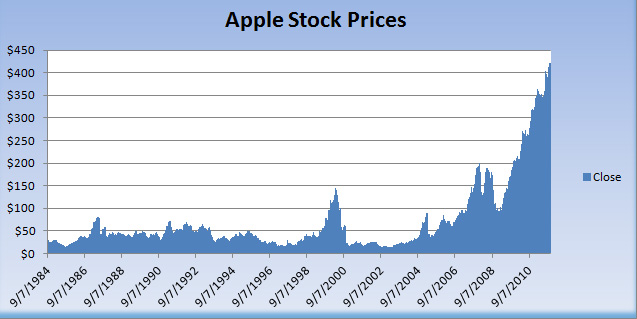
Apple Stock Prices from 1984 - 2011

The Rise Of Apple Stock Prices

What does the future of Apple look like without Steve Jobs? Analysts are predicting a very bright future.

Today, Apple is worth $377.83 billion dollars. Share prices are fluctuating between $401 – $409.  It is the largest company in the world and new products are in development.  The iTV, which is currently in the prototype stage, could revolutionize the television industry and it could add billions of dollars to the worth of Apple.

Gene Munster, analyst for Piper Jaffray, a $400 million dollar investment company, says “We believe that of the estimated 220 million flat panel TVs sold in 2012, 48% or 106 million units will be internet-connected, of which Apple could sell 1.4 million units,” Munster wrote. “We believe an Apple Television could add $2.5 billion or 2% to revenue in 2012, $4.0 billion or 3% in 2013 and $6.0 billion in 2014.”

Will that make investing in Apple now a good investment? David Zeiler writes an interesting article: Why Apple Stock Is Headed for $500 – And Beyond. The momentum behind Apple seems to be growing past the loss of it’s founder, Steve Jobs.

A recent book called “Steve Jobs,” by Walter Isaacson, clearly reveals the thinking that has been driving the success of the company for years. Steve’s out of the box, creative thinking has gotten the masses to use computers in a new way. From the launch of the MacIntosh in 1984, to the recent launch of the Ipad2, his products provided us with the next generation of technology.

Designing products with ease of use has been Steve Job’s philosophy. Thank goodness, because the masses are not tech geeks. His artistic sense of design, minimalistic lifestyle and obsessive attention to detail are the fuel behind the products we have come to love and use daily.

From his high school part-time job working at Hewlett-Packard, Steve Jobs found one mentor after the next to teach him about technology, product creating, business structure and relationships. Although not always the best at relationships, his demand for perfection and his drive for great product creation triumphed.

There is a future for Apple because of Steve Jobs. His vision and creative thinking will truly be missed, but his contributions to the world will benefit generation after generation.


Related Company Valuations – October 31, 2011


Apple Inc. 377.68B
Microsoft Corporation 225.50B
IBM 218.78B
Google Inc. 193.01B
Oracle Corporation 166.52B
Intel Corporation 129.99B
Verizon Communications… 105.09B
Amazon.com, Inc. 97.32B
Hewlett-Packard Company 53.35B
Dell Inc. 29.15B


1984 Launch of the Macintosh

 
Coolchecks.net, the best place to order checks.

Quickbooks Merchant Services Developer Earns Reward

Quickbooks Merchant Services Inventor

Hugh Molotsi of Intuit, receives an award of $1 million dollars.

On August 31, 2011, Hugh Molotsi received the “Founders Innovation Award,” for his role in the development of Quickbooks Merchant Services. An employee of Intuit for many years, Hugh discovered a business problem by talking to business owners about why they weren’t use credit card processing and the most frequent response he got was that they didn’t know how to do it.

Quickbooks Merchant Services Impact

Providing a solution to that problem was the beginning of the creation of Quickbooks Merchant Services which Hugh was instrumental in developing. It was released in 1999. Within two months, the business was profitable. Within the first year, they had 3,000 customers. The next year, business tripled to 10,000 customers and revenue tripled as well. Intuit’s future businesses were built on the fundamentals that the Quickbooks Merchant Services had. Now most of their customers, revenues and profits are from Quickbooks Merchant Services customers. Most of the Intuit businesses today and most of them for tomorrow are because of Quickbooks Merchant Services.

Through Hugh’s leadership he has earned two leadership in excellence awards and four of Intuit’s Innovation Awards. According to Intuit founder, Scott Cook, he is a classic leader and teacher. He is a continuous learner and focuses on self-improvement. He received Intuit’s special recognition, special access to Intuit events, and a financial reward of $1,000,000.00.

Intuit Company Development

Intuit has produced the popular accounting software, Quicken for personal finance, Quickbooks, and Turbo Tax. Intuit is a financial services company founded in 1983 by Scott Cook, former employee of Proctor & Gamble and Tom Proulx, a computer programmer studying at Stanford University. These two brilliant people worked together to help make people’s lives easier by creating the first software accounting program for families and businesses.

Intuit now has a revenue of $3.9 billion dollars, was ranked #44 by CNN as one of the top companies to work for and was ranked in Forbes magazine as one of the top 100 most inventive companies. Their mission statement is to remain “driven by our passion for inventing solutions to solve important problems, perfecting those solutions and delighting our customers.” Intuit makes a practice of rewarding their innovative employees by giving them special recognition and handsomely rewarding them financially. Intuit has become a success story inspiring people from all walks of life.


Founder of Intuit

Scott Cook co-founded Intuit Inc. in 1983 and now serves as the chairman of the Executive Committee. He earned an MBA from Harvard University and received a bachelor’s degree in economics and mathematics from the University of Southern California. Cook is a member of the board of directors of eBay; Procter & Gamble; the Asia Foundation; the Harvard Business School Dean’s Advisory Board; the Center for Brand and Product Management at the University of Wisconsin; and the Intuit Scholarship Foundation.
Quickbooks Checks

Bringing Bright Minds Together

September 5, 2011 by  
Filed under Business Development

Collaboration—with a capital C. In today’s business environment, what’s not to like about the concept of sharing information, asking questions, bouncing around bits of nascent, not-quite-formed ideas? Whether it’s formal, sit-down-at-a-table collaboration or the casual networking that goes on in the natural course of things, it has to be good.

It also can be tricky. Bill Gates, in a graduation address to students at his almost-alma mater, Harvard (he was introduced as the school’s most famous drop-out) defined the nature of interaction: “Being in the midst of so much energy and intelligence can be exhilarating, intimidating and sometimes even discouraging, but always challenging.”

John Abele

John Abele, co-founder and now director emeritus of Boston Scientific, a company that develops primarily medical products, expounded on the subject in a July 2011 article for Harvard Business Review. Like Gates, he recognizes the difficulties in bringing bright minds together. In fact, he says, the term “academic collaboration” is somewhat an oxymoron. Impediments include “the long-standing rituals of institutional seniority and the professional and financial incentives to build higher silos with thicker walls.”

But the effort is worth it, Abele emphasizes. “On the bright side, there’s an extraordinary opportunity for those of us non-academics who, unconstrained by those customs, see value in getting silos to collide.”

The Process of Collaborating

The process, he says, is “convincing people who don’t need to work together that they should.” That happens, he says, by inspiring the potential collaborators with a vision of change that is beyond their individual powers to bring about, convincing each that the others are not only vital to the process but that they are equal to the challenge. Then each member of the collaboration must be assured that that no one party to the collaboration is going to benefit to the total exclusion of others.

Leaders who are successful collaboration-builders, Abele said, are “passionately curious.” They have new insights and acknowledge that others may have them as well. They have the ability to bounce ideas off collaborators without being overly competitive. They care more about the success of the collective mission that they do about how success might benefit their personal fortunes.

Staying Focused

Dealing with egos when highly successful individuals come to the table can be a challenge. In an interview subsequent to his Review article, Abele described one gathering of the top thirty vascular surgeons in the world to discuss a proposed medical product. After a frustrating start, the thirty participants were each given a squirt gun. When anyone began to pontificate, Abele said, the others were advised to “use the weapon at hand.” A few doctors got completely soaked. That tactic “changed the dynamic of the meeting and it became very productive,” he said.

Five Tips For Collaboration

Those who function on the lower slopes of Mount Olympus may not have to resort to squirt guns to keep collaborators on track. But there are some rules that can lend themselves to a successful interaction. Among those advised by Abele and by commentators who responded to his article.

  1. Focus on the mission.
  2. Design a process beforehand.
  3. Don’t allow participants in a gathering to sell their products or services or to make attacks on competitors.
  4. Criticize ideas, not the people who advance them.
  5. Keep conversations energetic, constructive, free-wheeling and provocative.

Collaboration doesn’t always have to be among different companies. There is ample opportunity within a single organization for idea-sharing. Coordination and the free exchange of information among the various elements of an organization are essential to success. The same rules apply.

Making Positive Contributions

In his Review article, Abele quotes Margaret Mead, noted sociologist who conducted groundbreaking research in her field. “ Never underestimate the power of a small dedicated group of people to change the world. Indeed, it’s the only thing that ever has.”

That’s the nub of Collaboration—with a capital C.

Business Checks – Up to 50% off.

The Value of Scarcity and Uniqueness in Business

April 14, 2010 by  
Filed under Business Development

Auctions can bring hefty prices for unique, rare items. Recently, a manual typewriter fetched the amount of $254,000.

Why the astronomical price? You may wonder about this because living in the digital age, who needs a typewriter?

Possibly similar to the sale of one of Michael Jackson’s glove, this memorabilia belonged to Cormac McCarthy, American fiction writer. From this humble looking typewriter, McCarthy typed more than 5 million words over a period of 50 years.

The Lettera 32 Olivetti Typewriter

Cormac McCarthy, born in 1933, is an American novelist and playwright sometimes compared to Faulkner. Six of his novels were made into films. Well known for his 2007, Pulitzer prize winning, work of fiction called, “The Road.”

In 2008, McCarthy was awarded the Pen/Saul Bellow Award for Achievement in American Fiction. His work was recognized for qualities of excellence, ambition and scale of achievement during his writing career. This places him in the highest ranks of American literature.

People predicted his typewriter may go for $18K or so. Those predictions were far below the price it received. The large sum of money was donated to a scientific research organization, the Santa Fe Institute.

The qualities of uniqueness combined with scarcity can drive up the value of an item exponentially. With many competing businesses in similar niches popping up all over the web, thousands will collapse and a few will prosper. It seems to be a natural cycle of business.

If you want your Internet business to prosper, ask yourself if you have something to offer people that is both unique and scarce. The more you can meet this criteria, the better your business will do. What can you bring to the table that is different from every other company? Opportunities to create new, unique products are endless.

The entrepreneur in us sees opportunities everywhere we look, but many people see only problems everywhere they look. The entrepreneur in us is more concerned with discriminating between opportunities than he or she is with failing to see the opportunities. ~Michael Gerber

Developing Strong Leadership Skills

November 17, 2009 by  
Filed under Business Development

Having good leadership skills does not come easy. It is a long, ongoing process that consists of research and internalizing what was read and learned.  Training an individual to become a leader by learning from past and present leaders is one of the best methods. One can learn from or even acquire the good qualities of those great leaders.

There are several qualities present in a great leader and businessman. An individual running a business must have both in order to become successful. Here are a few tips:

Think and Act Like a Businessman/Businesswoman

In order to be a great businessman or businesswoman for that matter, you must think and act like one. Connect yourself to other individuals that share the same passion as you and those who can motivate you further.

Finances Inside and Out

Understanding how the finances work in the business and how to make the business grow differentiates the entrepreneur from the common employee. If you do not know what profit you made this month, you are in very big trouble.

Ads, Ads, Ads

A great business does not solely rely on the performance of its product alone, but relies heavily in its marketing. Research who the target market for the business is and how to effectively present your product or service to them.

Know Your Enemies

Like in the Art of War, it is also important to know and understand about the existing competition in order to build a successful business.

A Leader with a Mission

Have a clear mission and vision for the business. Motivate your employees to join you in attaining this mission and vision.

R-E-S-P-E-C-T

To be able to lead you would need to respect your employees and your clients. Respecting the people around you will be reciprocated with respect as well.

Passion

An exceptional leader is passionate in what he or she does. The best leaders are dedicated to their work and motivate other people to follow them.

Lead by Example

A great leader leads by example and is confident in what he or she does. By knowing every single detail about your business and doing what your employees do will encourage others to put their best efforts as well.

Confidence

The confidence a leader displays during times of uncertainty and doubt affects that of his peers and followers. Great leaders are calm even in disastrous situations and have the ability to direct or redirect attention to follow the key vision for the business.

Team Worker

Exemplary leaders also have the ability to work well with a group. In order to achieve a common goal, a great leader has the capacity and willingness to work with a team. A great leader sets the goal and makes appropriate steps in going towards that goal.

Excellence

Lastly, an excellent leader is dedicated to giving excellence in all aspects of the business. Great leaders do not waiver in terms of values and is passionate in setting the standards in the business higher.

These are some of the most important characteristics demonstrated by outstanding leaders and entrepreneurs. As previously mentioned, these are not often present in every individual and must be constantly learned, improved on and reinforced. Outstanding leaders and entrepreneurs have the capacity and willingness to adapt and learn to be better in their respective roles.